
HSS Sustainability for Procurement and Supply Chain Decisions
February 2026

Introduction
Sustainability requirements for structural materials are increasingly influencing project specifications and procurement decisions. These decisions require a clear understanding of how the product is manufactured, how environmental impacts are measured and reported, and how supply chain choices affect the embodied carbon of the installed product. This requires procurement teams and project stakeholders to evaluate environmental performance using Environmental Product Declarations (EPDs), recycled content information, and project-specific embodied carbon thresholds.
This article provides practical, procurement-focused guidance on Hollow Structural Sections (HSS) sustainability. It explains the HSS manufacturing and supply chain, how embodied carbon is quantified through life cycle assessment and EPDs, and how availability, substitutions, and documentation requirements can affect compliance with green building programs and public procurement policies. The intent is to help service centers, fabricators, general contractors, and other stakeholders make informed sourcing decisions and confidently respond to project sustainability requirements when specifying and supplying HSS.
HSS Manufacturing and Supply Chain
HSS is manufactured by cold-forming and welding steel coils into tubes of various dimensions and shapes and may be fabricated before installation. Like most steel products, 90% or more of the environmental impacts of HSS are associated with the steelmaking processes (STI, 2021). In the U.S., most of the steel used in HSS manufacturing is sourced domestically. Steel serves as a backbone of modern industry and bolsters the U.S. economy with the domestic steel industry supporting approximately two million jobs directly and indirectly (AISI, 2018). For decades in the U.S., producers of steel have invested in improving energy efficiency, reducing environmental impacts, and advancing recycling infrastructure.
Nearly 71% of the steel produced in the U.S. in 2020 was made via the electric arc furnace (EAF) process, versus only 26% on average globally (AISI, 2023). On average, EAF sheet mills melt more than 50% scrap inputs using electricity and are less energy intensive and emit fewer greenhouse gas (GHG) emissions than integrated blast furnace / basic oxygen furnace (BF/BOF) mills that reduce iron ore to form steel with a maximum of around 30% scrap input; however, EAF impacts can vary based on electricity source and the share of scrap inputs (worldsteel, 2024; GEI, 2022). All of this paired with less GHG-intensive energy sources, including electricity grid mixes, has resulted in the domestic steel industry having the lowest GHG intensity of all major steel producing regions in the world (GEI, 2022). Steel products are also inherently circular, due to their recycled content, proven strength and durability during use, and years of demonstrated high recycling rates at end-of-life. Recycled steel scrap can make up over half of HSS products and structural steel has a recycling rate of 97% at end-of-life (AISI and SMA, 2021).
Measuring HSS Sustainability
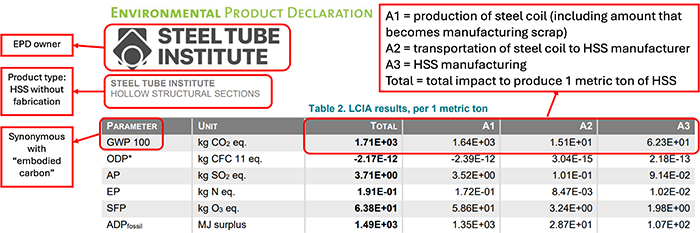
Sustainability, though a broader concept, is often viewed in terms of a product or system’s effects on the environment. Embodied carbon is one measure of sustainability that refers to the quantity of GHGs emitted from “cradle-to-gate”, meaning from the extraction of raw materials, upstream transportation, and manufacturing processes of a product (EPA, 2025). It is calculated using life cycle assessment (LCA) methods and reported as a 100-year Global Warming Potential (GWP-100) metric alongside other potential impacts in Environmental Product Declarations (EPDs) (STI, 2022; EPA, 2024). For steel products manufactured from mill-level products, like HSS, A1 in an EPD will represent the cradle-to-steel mill gate (steel coil production), A2 is transportation to manufacturing, and A3 is the HSS manufacturing process, like is shown in Figure 1. There is a trend towards increased supply chain specificity in EPDs, which is prioritized in the Smart EPD Steel Construction Products version 3 (v3) PCR (Smart EPD, 2025), meaning the use of industry average data in A1 is transitioning to data representative of the facilities that supply steel coil and other mill-level products to steel product manufacturers. A1 will typically represent a mix of EAF and BF/BOF steel production as both are prevalent in the domestic HSS supply chain. EPDs report environmental impact results in tabular format. Figure 2 shows an example of the contents and key data, including embodied carbon, for STI’s industry-average HSS EPD. The embodied carbon result is the sum of the GWP-100 results in Modules A1-A3, i.e., the “Total” column in the example below.

HSS, like other structural steel products, is typically fabricated prior to installation. Some EPDs include the fabrication process, which changes the scope of Modules A1-A3 as follows: A1 includes the production of steel coil, transport of steel coil to HSS manufacturers, and HSS manufacturing, A2 represents transport from the HSS manufacturers to fabricators, and A3 represents the fabrication process. A1 will include the amount of HSS needed to account for fabrication scrap generated in A3, so use caution when comparing these results to an EPD representing unfabricated HSS. Fabrication occurs at numerous facilities throughout the U.S., and the impacts of the fabrication process are typically based on industry-wide data collected and published by the American Institute of Steel Construction (AISC, 2021).
Sustainable HSS Availability
EPDs have evolved from voluntary disclosures, incentivized by green building rating systems like LEED v4 released in 2013, to now being considered mandatory for green public procurement programs, including the General Services Administration’s (GSA’s) 2023 Low Embodied Carbon Program (GSA, 2025), Buy Clean California (2017) and other state-level Buy Clean programs, and embodied carbon provisions of California’s building code (2023-2025). These programs require facility-specific EPDs that report a GWP-100 value, like is shown in Figure 2, lower than the applicable published thresholds. Some projects outside of those subjected to state and federal procurement requirements are now incorporating similar thresholds in material specifications. Unlike industry-wide EPDs that present production-weighted average results for a given geography, facility-specific EPDs list a single manufacturer as the EPD owner and present GWP-100 results for a specific facility or sometimes multiple facilities. These values are the ones to be compared to specific thresholds.
During early project design, industry-average data including industry-wide EPDs, is often used to represent impacts of specific materials or products. During procurement, it is necessary to secure a facility-specific EPD that represents the product manufacturer and facility selected for installation. It is also important to consider changes during construction where the selected product is not readily available or delayed. Sourcing alternate products/sizes which meet physical or structural requirements should also be evaluated for lower or equivalent costs and embodied carbon impacts. The EPD provided for the original product may not represent the new substituted product if not from the same producer and the same manufacturing location. Transportation costs and associated impacts, which are often excluded from cradle-to-gate EPDs, should also be carefully assessed. If the original EPD is not representative of the substituted product, a new EPD(s) must be acquired and recorded for all potential project changes which meet project requirements. If not provided with other product documentation, industry-average and facility-specific HSS EPDs can be easily accessed on STI’s website.
Some project specifications may also require a minimum recycled content threshold or only EAF-sourced steel. Recycled content is sometimes reported in the product composition section of EPDs available today and will be required for all new EPDs published under the v3 PCR. Alternatively, HSS producers often include the coil source and recycled content in the material test reports issued to their customers alongside the product they purchase. If not available in either of those options, a recycled content or “LEED” letter can often be found on the manufacturer’s website or requested. Unless it is specified that the HSS product was produced only with EAF steel, it is likely that the supply chain includes a mix of both BF/BOF and EAF steel sources, though an inquiry can be placed with the manufacturer to confirm.
Ultimately, in this quickly evolving space, the manufacturers of HSS in the U.S. are working diligently to transparently report the impacts of their products, while continuing to work with their suppliers to reduce the impacts of their materials. As questions arise, please contact the Steel Tube Institute and its members who stand ready to support fabricators, service centers, and contractors to ensure HSS remains a key solution for sustainable construction practices.
References
AISC, 2021. American Institute of Steel Construction, Environmental Product Declarations, accessed June 2025: https://www.aisc.org/why-steel/resources/leed-v4/.
AISI, 2023. American Iron and Steel Institute, AISI Industry Profile Book, updated March 2023, available at: https://www.steel.org/wp-content/uploads/2024/01/AISI-Profile-Book_updated-3.2023.pdf.
AISI, 2018. American Iron and Steel Institute, Economic Impact Report, 2018, available at: https://www.steel.org/economicimpact/.
AISI and SMA, 2021. American Iron and Steel Institute and Steel Manufacturers Association Technical Report. Determination of Steel Recycling Rates in the US, July 2021. https://www.steel.org/wp-content/uploads/2021/08/AISI-and-SMA-Steel-Recycling-Rates-Report-Final-07-27-2021.pdf.
EPA, 2025. U.S. Environmental Protection Agency, C-MORE: Construction Material Opportunities to Reduce Emissions, website, last updated January 16, 2025: https://www.epa.gov/greenerproducts/cmore.
EPA, 2024. U.S. Environmental Protection Agency, EPD Basics: A Manufacturer’s Guide to How and Why to Develop an Environmental Product Declaration, December 2024, available at: https://www.epa.gov/system/files/documents/2024-11/epd_basics_how_why_to_develop.pdf.
GEI, 2022. Global Efficiency Intelligence, Steel Climate Impact An International Benchmarking of Energy and CO2 Intensities, April 2022, available at: https://www.globalefficiencyintel.com/steel-climate-impact-international-benchmarking-energy-co2-intensities.
GSA, 2025. General Services Administration, Low Embodied Carbon Program, website, last updated June 26, 2025: https://www.gsa.gov/real-estate/gsa-properties/inflation-reduction-act/lec-program-details.
Smart EPD, 2025. PCR Part B for Designated Steel Construction (Standard 1000-008), April 2025, available at: https://smartepd.com/pcr-library.
STI, 2022. Steel Tube Institute, EPD: Achieving Green Goals with HSS, September 2022, article available at http://steeltubeinstitute.org.
STI, 2021. Steel Tube Institute (STI), Hollow Structural Sections Environmental Product Declaration, 2021, available at: https://steeltubeinstitute.org/resources/leed-epd/.
worldsteel, 2024. World Steel Association, Sustainability Indicators: 2024 Report, available at: https://worldsteel.org/wider-sustainability/sustainability-indicators/.