
Practical Guide to HSS Sustainability Documentation and Submittals
January 2026
Whether you’re quoting HSS, fulfilling an order, sourcing alternates, or responding to sustainability documentation requests, this guide provides the practical background and tools needed to address project sustainability requirements quickly, accurately, and confidently.
WHY SUSTAINABILITY MATTERS NOW
Projects across the U.S. are increasingly requiring low-embodied carbon materials, including steel. This is currently driven by:
- State-level policies (e.g., Buy Clean California and the Buy Clean Colorado Act)
- Private sector and institutional sustainability goals
- Certifications such as LEED v5
The result? You may be asked to provide environmental documentation (e.g., Environmental Product Declarations, or “EPDs”), respond to substitution requirements, or ensure compliance with GWP (Global Warming Potential) limits. If your responses are incomplete, outdated, or mismatched, your submittals could be rejected.
WHAT IS HSS AND HOW IS IT MADE?
Hollow Structural Sections (HSS) are welded steel tubes used for structural framing in buildings, bridges, and infrastructure. Most HSS used in U.S. construction is domestically produced from U.S.-sourced steel coil.
HSS Manufacturing Overview:
- Steel Coil Production – Steel coil is made using one of two steelmaking processes at a steel mill: the Electric Arc Furnace (EAF) or the integrated Blast Furnace – Basic Oxygen Furnace (BF-BOF) process (see Table 1). The coil is then transported from the steel mill to the HSS producer for tube forming.
- Tube Forming – The coil is slit, formed into square, round, or rectangular shapes, and welded along it’s length. The tube is then transported from the HSS producer to the fabricator.
- Fabrication – Operations like cutting, coping, drilling, and welding to meet specific project needs.
Note: More than 90% of the environmental impact of HSS is in the Steel Coil Production phase, prior to reaching the HSS producer’s facility for Tube Forming.
STEELMAKING PROCESS MATTERS: EAF VS. INTEGRATED (BF-BOF)
The steel used to make HSS can come from two different steelmaking processes, each with a very different environmental footprint.
| Process | Description | U.S. Breakdown (2021) | Global Breakdown | Typical GHG (Greenhouse Gas) Impact |
| EAF (ELECTRIC ARC FURNACE) | Melts a majority of scrap steel using electricity | 70% | 29% | Lower emissions |
| INTEGRATED (BF-BOF: BLAST FURNACE – BASIC OXYGEN FURNACE) | Uses mainly virgin iron inputs and coal | 30% | 71% | Higher emissions |
Note: Most EPDs for HSS reflect what is referred to as a blended average of EAF and BF/BOF inputs, based on the HSS producer’s supply chain specific coil input, or using industry-average data to represent the market average. A few producers now offer EAF-only facility-specific EPDs in addition to their blended EPD.
EPDs AND WHAT THEY MEAN
An EPD or Environmental Product Declaration is an ISO-conformant, third-party verified document that reports the potential environmental impacts of a product over specific life cycle stages.
The most commonly used measure of sustainability in construction is embodied carbon, which is reported as Global Warming Potential (GWP), expressed in kg CO₂-equivalent per metric ton of material. The GWP of a product is included in every EPD.
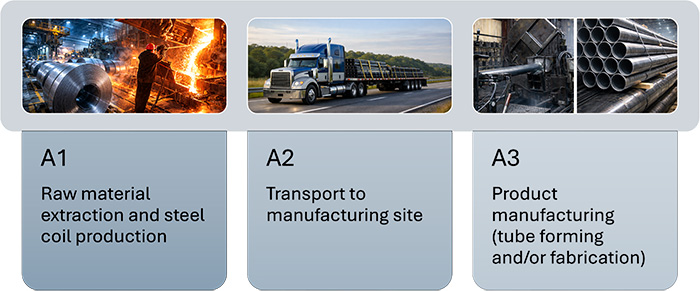
EPDs are organized by life cycle stages:
FABRICATED VS. UNFABRICATED HSS EPDs
Unfabricated HSS refers to tube that has been formed at an HSS production facility, but does not include downstream fabrication, while fabricated HSS includes additional operations that take place at a fabrication shop, such as cutting, drilling and welding. One of the most common mistakes in EPD evaluation is comparing fabricated HSS results with unfabricated HSS results without adjusting for scope. The A1–A3 boundaries in an EPD differ depending on whether the HSS product is fabricated or unfabricated.
Table 2: EPD Scope Comparison
| A1 | A2 | A3 | |
| UNFABRICATED | Steel coil production (plus overage for manufacturing scrap) | Transport to HSS producer/manufacturer | Tube forming and welding |
| FABRICATED | Steel coil production and tube forming/HSS production (plus overage for fabrication scrap) | Transport to fabricator | Steel fabrication |
Key point: Fabricated HSS EPDs include emissions from downstream fabrication processes (e.g., cutting, coping, welding) in A3, and account for fabrication scrap in A1.
✅ Always compare EPD GWP results of the same type (fabricated-to-fabricated or unfabricated-to-unfabricated).
✅ Confirm what’s included in the scope before calculating totals or making comparisons.
INDUSTRY-WIDE VS. MANUFACTURER-SPECIFIC VS. FACILITY-SPECIFIC EPDs
The HSS industry is well represented in the EPD landscape, with industry-average EPDs for both unfabricated and fabricated HSS, as well as numerous facility-specific EPDs. Keep in mind that as new data becomes available and sustainability policies evolve, EPDs are being updated; if an EPD is expired or nearing expiration, a newer version for the same product and facility may already be available. Note: An updated industrywide HSS EPD is anticipated in summer 2026.
Table 3: EPD Representativeness Comparison
| EPD Type | What It Represents | Where Can I Find It | When To Use |
| INDUSTRY-WIDE | Production-weighted averages across multiple manufacturers and facilities. | There are currently two industry-wide HSS EPDs, one unfabricated and one fabricated. The fabricated EPD simply builds on the unfabricated EPD by incorporating the additional impacts associated with fabrication. Both can be found on Steel Tube Institute’s website: Unfabricated Industry-wide HSS EPD Fabricated Industry-wide HSS EPD | Early design analysis, education, and establishing thresholds/benchmarks. |
| MANUFACTURER-SPECIFIC | Impacts representative of a single manufacturer’s HSS production, based on either a single facility or an average across multiple facilities. | Steel Tube Institute website or on the individual HSS producer’s website. Note: All STI HSS member producer EPDs are considered to be both manufacturer-specific and facility-specific. | Projects where manufacturer-level reporting is acceptable and facility-specific EPDs are not required. |
| FACILITY-SPECIFIC | Impacts calculated for HSS produced at one specific manufacturing facility. The manufacturer may include each of their facilities in one EPD or publish a separate EPD for each facility. | Steel Tube Institute website or on the individual HSS producer’s website. Note: All STI HSS member producer EPDs are considered to be both manufacturer-specific and facility-specific. | When required for Buy Clean, and project-specific specifications with GWP thresholds. |
WHAT YOUR TEAM MAY BE ASKED
These are realistic questions your team may need to respond to, or may need to ask upstream suppliers:
Table 4: Guidance for Potential Questions
| Topic | Practical Questions | How To Respond |
| EPDS | “Can you provide a facility-specific EPD for this HSS?” | First, check your records for a valid (i.e., not expired) EPD that matches the product type and facility. If none, you can find facility specific EPDs on the Steel Tube Institute’s website or on the HSS producer’s website. |
| GWP | “What’s the GWP for A1–A3?” | In the EPD, look for the Life Cycle Impact Assessment (LCIA) results table or the GWP-100 table. Once you have found the table, look for the “Total” or “Total (A1-A3)” column. Ensure alignment of fabricated or unfabricated scope by checking the table title and your project spec. |
| SOURCE | “Is this EPD for EAF steel or blended?” | Check the EPD title and product description. EAF-only EPDs will clearly indicate this. If not, you can assume the steel coil supply is from blended sources. |
| FABRICATION | “Is this GWP for fabricated or unfabricated product?” | If you are looking at an EPD table, the title of the table will likely indicate whether the values are for fabricated or unfabricated HSS. Otherwise, ask the HSS producer for clarification. Many EPDs show both fabricated and unfabricated GWP. |
| RECYCLED CONTENT | “Can you provide a letter showing recycled content?” | If a recycled content letter is required per the project specification, first check the manufacturer website for a recycled content or “LEED” letter. If none found, contact the manufacturer. In the future, recycled content may also be included in HSS EPDs. |
FINAL WORD
Sustainability is a lasting consideration for product procurement in the construction space. Whether you’re on the phone quoting a job or troubleshooting a submittal, you have a significant role to play in getting it right.
The Steel Tube Institute and its members are here to help, via support and up-to-date resources.
Need help with an EPD or sustainability documentation?
Visit steeltubeinstitute.org or reach out to the STI.