
Strength and Deformation of HSS Walls and Other Planar Elements Subject to Tension
by David G. Brown, BEng, CEng, MICE
Structural Engineering Consultant, BlindBolt, UK
March 2026
Introduction
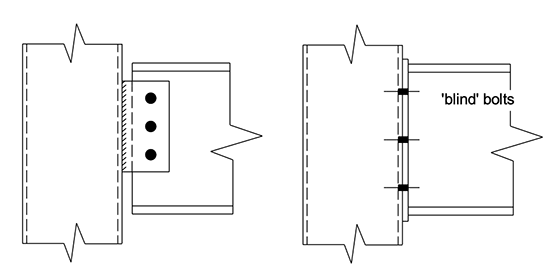
Designers are often faced with connections to planar elements, such as beam webs or the walls of HSS. If the connection is to be bolted, typical details include single-plate connections or some form of blind fastener, as shown in Figure 1.
In both cases, if tension is applied to the connection, the strength of the supporting element must be verified. AISC 360-22 Section J3.13 specifies that if bolts or other fasteners in tension are attached to an unstiffened box or HSS wall, the strength of the wall shall be determined by rational analysis. Although the clause is specific to HSS, the principle is appropriate for connections to any planar element. When any concentrated force is applied to a planar element, by a plate or by fasteners, the deformation of the planar element should be considered. Deformation rather than strength may be the limiting resistance. The focus of this article is connections made with so-called “blind” fasteners, considering both strength and deformation.
Rational Resistance Checks
Whilst AISC 360-22 clause J3.13 refers to a “rational analysis”, no further guidance is provided. The commentary suggests that the limit states may include a yield line mechanism or pull-out through the wall, in addition to the applicable limit states for the fasteners themselves.
In addition to strength, designers should consider the deformation of the wall or planar element, as this may be as important as strength. The concern is the overall deformation of the plate or wall face, which will become unacceptable at much lower load levels than any concerns about the resistance of the fastener.
The importance of these checks on the HSS wall cannot be over-emphasised, as they are generally the critical verification. In the author’s experience, many designers are interested in the tensile resistance of the fastener itself, when the critical check is generally the resistance of the planar element to which the fasteners are connected.
CIDECT and AISC Design Guide 24
For several decades CIDECT (International Committee for the Development and Study of Tubular Construction) were very active in researching all aspects of design and construction using hollow structural sections. This includes work on welded joints between hollow structural sections which form much of the basis of Chapter K of AISC 360-22. Although CIDECT is no longer active (2026), their several design guides are excellent sources of information and guidance. CIDECT Design Guide 91, published in 2004, provides an expression for the resistance of a hollow section face in equation 6.27 of the guide. The CIDECT guidance is generally used across Europe.
More recently, AISC published the second edition of Design Guide 242, which, like the CIDECT guidance, contains expressions for the resistance of a hollow structural section wall subject to tension. The expressions in Design Guide 24 consider strength alone, whilst the CIDECT guidance also limits the deformation of the hollow structural section wall, leading to a lower resistance.
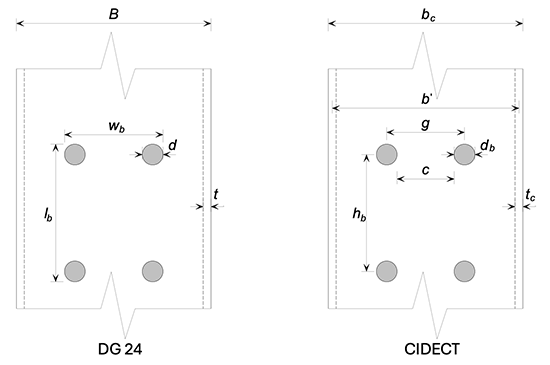
In Design Guide 24, the strength of the hollow structural section wall is given in equation 4-2, presented below. Relevant dimensions are shown in Figure 2.
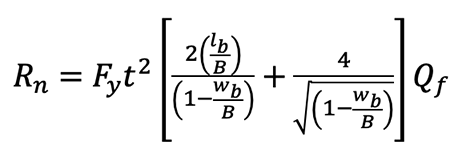
Fy is the yield strength of the section
t is the thickness of the HSS wall
lb is the length of the bolt group
wb is the width of the bolt group
B is the width of the HSS face
Qf Is a function to account for the compression in the face of the HSS
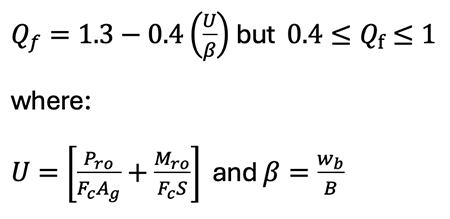
The definition of lb and wb should be carefully noted with reference to Figure 2, being very clearly indicated in Figures 4-2 and 4-13 of DG 24, 2nd Ed. There is some inconsistency in Example 4.3 of DG 24, 2nd Ed, where it appears the bolt centreline dimensions are used in place of lb and wb.
The CIDECT guide uses subtly different dimensions as shown in Figure 2, so care must be taken if results are to be compared.
The CIDECT expression for the resistance of the hollow structural section wall is presented below.

where:
fcy is the yield strength of the section
tc is the thickness of the HSS wall
g is the distance between the centrelines of the fasteners in the transverse direction
hb is the distance between the centrelines of the fasteners in the longitudinal direction
db is the diameter of the fastener
bc is the overall width of the QHSS
c = g – db
b’ = bc – tc
f(n) is a function to account for compression in the face of the HSS, given by: f(n) = 1 + n ≤ 1.0
n = longitudinal stress in column/column yield stress (compression is negative)
It will be readily observed that apart from the functions Qf and f(n), the two expressions are very similar.
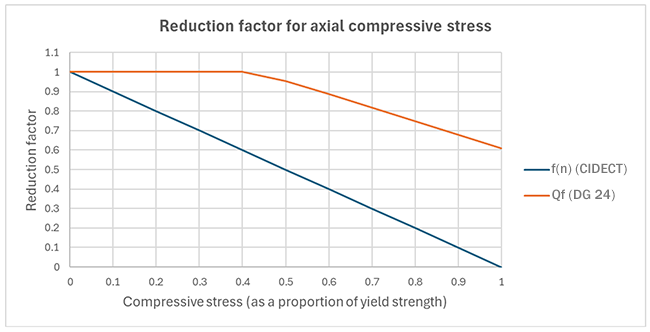
Chord stress effect reduction factor Qf
The resistance of the HSS wall is based on the plastic resistance of a yield line pattern. The Von Mises criteria demonstrates that the resistance of yield lines cannot be fully realised in the presence of normal (longitudinal) stress – either longitudinal compression or tension. If the longitudinal stress is compression, it will amplify the local buckling of the HSS face in the connection zone. If the longitudinal stress is tension, it will serve to resist the local buckling of the face and is deemed to compensate for the reduction in the plastic resistance of the yield lines. The function Qf therefore applies if the longitudinal stress in the chord face is a net compression under the action of the longitudinal force and any bending moment. If the HSS face is under net tension, Qf = 1.0
CIDECT guidance also applies a reduction factor when the longitudinal stress in the HSS face is compression. The reduction factors are quite different, as shown in Figure 3. In the CIDECT guidance, there is always a reduction, even at low levels of axial compressive stress. In Design Guide 24, a reduction is only applied when the net compressive stress exceeds a certain proportion of the yield strength. A comparison between the two formulae for a typical value of β=0.58 is shown in Figure 3. For smaller values of β (a relatively narrow bolt group in the flange), the reduction starts earlier. For larger values of β (a wide bolt group compared to the flange), the reduction starts at higher levels of compressive stress. In DG 24, the reduction factor is never more severe than 0.4.
Why CIDECT guidance remains relevant
The physical deformation of the HSS wall (or any other connecting element) is often important, particularly so with bolted joints. The concern is not that local deformation may lead to premature pull-through of the fastener, but that with fasteners under tension the deformation of the connecting element may be unsightly and permanent.
The connection capacities calculated in Chapter K of AISC 360-22 and in DG24 are based on strength limit states only. In contrast, the CIDECT design equations are arranged to consider strength and to limit the deformation of the HSS wall.
The commentary to Chapter K of AISC 360-22 suggests that where connection deformations would be a concern due to serviceability or stability, the CIDECT guidance could be used.
The CIDECT guidance limits the deformation of the HSS wall to 3% of its width. This limit is not explicitly seen within the resistance expressions, but as the following examples demonstrate, the CIDECT guidance results in a lower resistance value than DG 24.
Numerical Examples
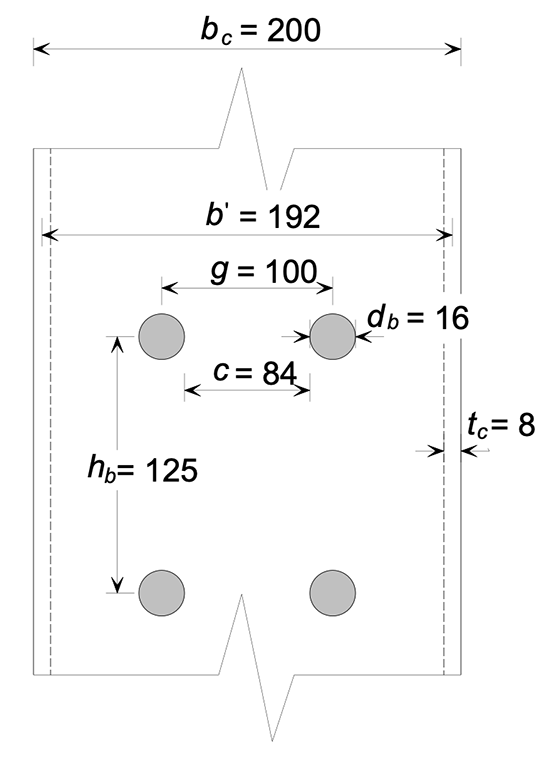
A bolted connection to an HSS wall as shown in Figure 4 is subject to tension. The longitudinal stress in the HSS is initially assumed to be tension (to exclude the impact of the chord stress effect reduction factors).
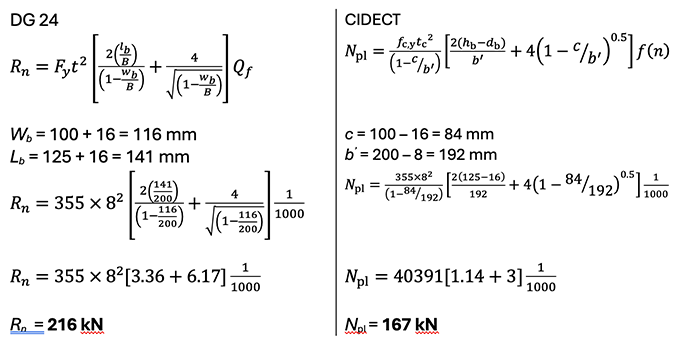
The comparisons are more dramatic if the longitudinal stress is compression.
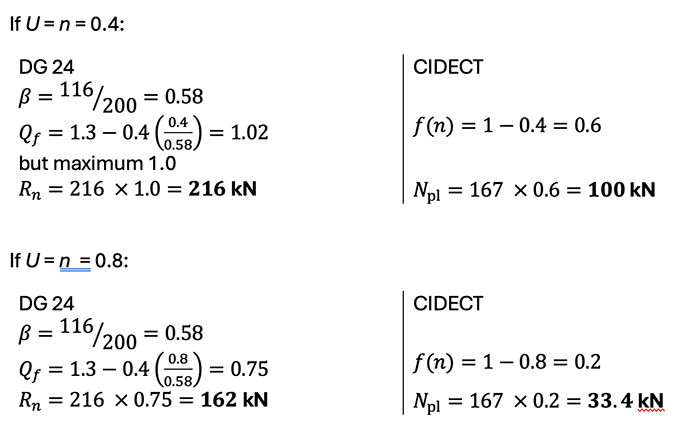
The considerable differences between DG24 and CIDECT results is discussed further in the ‘Recommendations to Designers’ portion of this article.
The DG 24 and CIDECT formulae are amenable to spreadsheet solutions – a simple design tool for checking the wall resistance (in both metric and imperial units) is available at https://www.blindbolt.com/technical/design-tools/, allowing the wall resistance to be quickly calculated to both the DG 24 and CIDECT design rules.
Software Solutions
An increasingly popular approach to connection verification is design supported by Finite Element (FE) Analysis. Many software programs are available which can be used to model complex joints, illustrating the stress distribution, reporting the calculated forces in fasteners and showing the deformed arrangement. Care is needed with modelling, with the assumptions made within the software and in the interpretation of the results. Common with the use of any software, a comparison of results with a straightforward benchmark connection completed by hand is recommended, not least so that differences can be identified and investigated.
One FE-based program growing in popularity in Europe is IDEA StatiCA3, which can be used to model very many different types of joint. One particular feature of IDEA StatiCa is that the local deformation of the hollow section is reported by the software and compared to the 3% limit noted above. A second notable feature is that IDEA StatiCA allows plasticity, up to a strain limit of 5%.
IDEA StatiCA was used to model the connection detailed in Figure 4. A horizontal beam with a very thick end plate was used to apply load uniformly to the bolts, which in turn loaded the wall of the HSS. Load was applied in an iterative manner to investigate the maximum tensile load which could be applied to the HSS, in the three situations previously discussed:

- Zero longitudinal stress in the HSS,
- A longitudinal compressive stress of 40% of the yield strength,
- A longitudinal compressive stress of 80% of the yield strength.
With zero longitudinal stress in the HSS, the maximum tensile load in the joint was found to be approximately 220 kN. This compares favourably with the 216 kN determined in accordance with DG24. At this level of load, the plastic strain was 4.8% (close to the limit of 5%) and the local deformation of the HSS was 2.3%. The software presents a graphic of the deformation, as shown in Figure 5, where the deformation is magnified by a factor of 20.
With a longitudinal compressive stress equal to 40% of yield strength, the maximum tension that could be applied to the joint was approximately 200 kN (not a significant reduction from 220 kN). The plastic strain was 4.9% and the local deformation still 2.3%. This is again a favourable comparison with the 216 kN calculated in accordance with DG24.
With a longitudinal compressive stress equal to 80% of yield strength, an analysis could not be completed even at trivial levels of tension applied to the joint. This result appears to have more correspondence with the CIDECT resistance of 33 kN than the DG24 value of 167 kN.
Recommendations for Designers
The purpose of this article has been to remind designers that if blind fasteners subject to tension are connected to the wall of a HSS (or any similar planar element) the verification of that supporting element is a critical part of the joint design. The supporting element is almost certain to be the critical component – blind bolts can be readily specified to accommodate the order of force in the bolts in the preceding examples. Design Guide 24 and the recommendations from CIDECT are both appropriate rational analyses, as required by AISC 360-22. The CIDECT guidance is clearly more conservative, perhaps partly because the local deformation limit of 3% of the wall width is applied.
Comparing the reduction factors illustrated in Figure 3, the CIDECT reduction factor appears likely to be conservative. Although DG24 is consistent with the AISC 360-22 specification in not including deformation limit states within its available strength design equations, both resources refer to the CIDECT guidance if deformations are a concern. Deformation is more likely to be a concern if fasteners are located towards the centre of a wide, thin-walled HSS.
Software may be used to verify the joint resistance, including the local deformation of the HSS wall. There was reasonable agreement to DG24 with zero longitudinal and 40% stress in the HSS. The limited investigation reported in this article was inconclusive at 80% compressive stress, as a software analysis could not be completed at this stress level. Using software may be particularly attractive when the joint details are unorthodox, noting that the focus of both DG 24 and CIDECT is bolt groups placed centrally in the HSS wall.
References
1 Kurobane, Y., Packer, J.A., Wardenier, J., and Yeomans, N. (2004). “Design Guide for Structural Hollow Section Column Connections”. CIDECT Design Guide 9. TÜV-Verlag GmbH.
2 Packer, J.A. and Olson, K. (2024). “Hollow Structural Section Connections”. AISC Design Guide 24, 2nd Ed. American Institute of Steel Construction, Chicago, IL.
3 IDEA StatiCa. Finite element–based structural design software. https://www.ideastatica.com
Related Resources
HSS Bolted Connections: Keep It Together With a Bolt of Confidence
This article reviews common bolted HSS connection configurations and key design considerations, including shear, splice, brace, th…
HSS Design Manual, Volume 4: Truss & Bracing Connections
The STI HSS Design Manual, Volume 4 features HSS truss and bracing connection design examples, including connections utilizing HSS…
A Jolt of Bolting – How to Use Them in HSS Connections | Webinars On Demand
Dive into the world of bolting options for HSS. This webinar covers everything from conventional bolts and through-bolts to access…
Video | End Plate Splice Types: Key Insights to Simplify Your HSS Designs
Several types of HSS end splices are available, each offering unique advantages. In this clip, we provide an overview of bolted en…