
HSS Brace Connections to HSS Column and WF Beam
By: By Jeffrey Packer, Ph.D., D.Sc., P.Eng., Bahen/Tanenbaum Professor of Civil Engineering, University of Toronto
Sam Richardson, MASc Candidate, Department of Civil and Mineral Engineering, University of Toronto
August, 2025

A beam-to-column connection in a braced frame is shown in Figure 1, with selected members subject to the factored loads indicated. A connection design will be performed using Group 150 7/8” bolts with threads included in the shear plane (thread condition N), with standard holes in the beam web, plates, and angles. The HSS column and brace are ASTM A500/A500M Grade C, the beam is ASTM A992/A992M, the four clip angles and the plates are ASTM A572/A572M Grade 50. Weld electrodes are 70 ksi.

From AISC Manual Tables 2-4 and 2-5, the material properties are as follows:
| Column and Brace ASTM A500/A500M Grade C Fy = 50 ksi Fu = 62 ksi | Clip Angles ASTM A572/A572M Grade 50 Fy = 50 ksi Fu = 65 ksi |
| Beam ASTM A992/A992M Fy = 50 ksi Fu = 65 ksi | Plates ASTM A572/A572M Grade 50 Fy = 50 ksi Fu = 65 ksi |
From AISC Manual Tables 1-1 and 1-12, the geometric properties are as follows:
| Beam W18×143 tw = 0.730 in. d = 19-1/2 in. T = 15-1/8 in. | Column HSS10×10×1/2 B = 10.0 in. H = 10.0 in. t = 0.465 in. A = 17.2 in.2 | Brace HSS6×6×3/8 B = 6.0 in. H = 6.0 in. t = 0.349 in. A = 7.58 in.2 |
Force Transfer in Diagonal Bracing Connections: The Uniform Force Method (Manual Part 13)
The distance from the face of the column flange to the ideal centroid of the gusset-to-beam connection is (by First Moments of Area):

The distance from the face of the beam top flange to the ideal centroid of the gusset-to-beam connection is (by First Moments of Area):

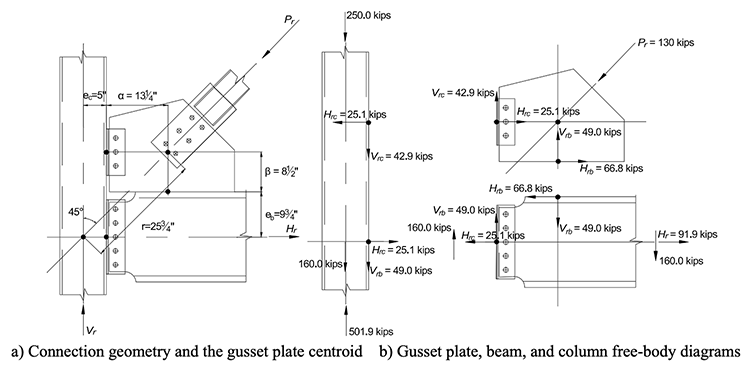
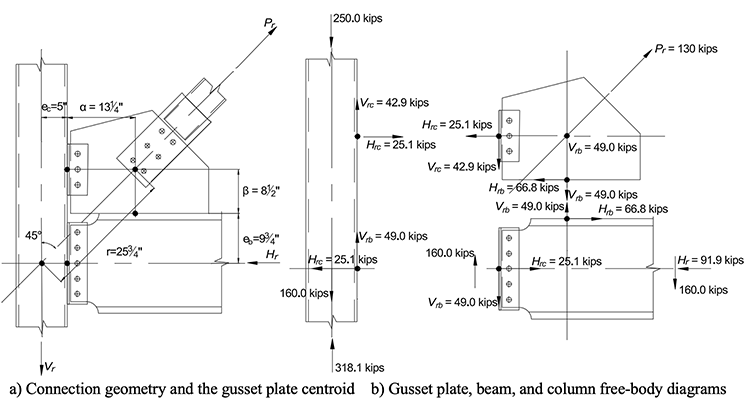
To use the uniform force method, the geometry in Figure 2-a must satisfy the following expression:
α – β tan(θ) = eb tan(θ) – ec (from Manual Eq. 13-1)
eb = 9.75 in. (one-half the depth of the beam)
ec = 5 in. (one-half the depth of the column)
θ = 45° (angle between the brace axis and vertical)
13-1/4 in. – (8-1/2 in.)tan(45°) = (9.75 in.)tan(45°) – 5in.
4.75 in. = 4.75 in. o.k.
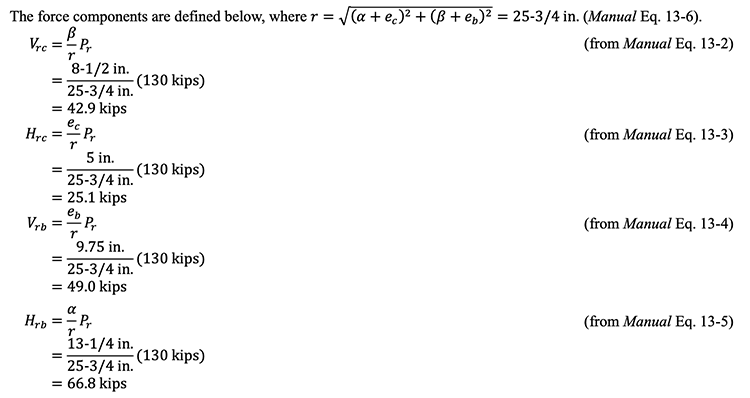
This means that no moments act at the interfaces between the gusset plate, beam, and column (Dranger & Thornton, 2025). Therefore, the forces may be partitioned per the uniform force method. This results in the free-body diagrams for the gusset plate, beam, and column, as shown in Figure 2-b (Dranger & Thornton, 2025).
Strength of the fillet welds between the HSS and splice plate
Assuming the HSS slot is 1/16 in. wider than the gusset thickness, the gap for either weld will not exceed 1/16 in., so no adjustment of the weld size is required per AWS D1.1/D1.1M. Therefore, the weld effective size is the full weld: w= 1/4 in. From AISC Design Guide 24 Table 3-3, tmin = 0.200 in. for ASTM A500/A500M Grade C HSS with a 1/4 in. weld size. The design thickness of the HSS (t = 0.349 in.) is greater than tmin = 0.200 in. Therefore, the shear strength of the weld metal controls over the shear strength of the HSS base metal.
From AISC Specification Section J2.4, the available weld strength, per unit length, is:

From the AISC Specifications Table J2.4 the minimum weld size is 3/16 in. Therefore, a 1/4 in. size is sufficient.
Strength of the bolts between the splice plate and gusset plate (lap connection)
The available strength of a 7/8 in. Group 150 bolt (condition N) in single shear is given as 30.7 kips per bolt in Table 7-1 of the AISC Manual.
The available strength of the bolts in bearing is given by AISC Specification Section J3.11, assuming deformation at service load is a design consideration.
ϕRn = ϕ2.4dtFu (from Spec. Eq. J3-6a)
= 0.75(2.4)(7/8 in.)(3/4 in.)(65 ksi)
= 51.2 kips/bolt
Therefore, the strength of the bolt group is governed by bolt shear.
(6 bolts)(30.7 kips/bolt) = 184.2 kips > 130 kips o.k.
Bolt spacing requirements:
Minimum edge distance = 1 1/8 in. < 2 in. o.k. (from Spec. Table J3.4)
Maximum edge distance =12tp = 12(3/4 in.) = 9 in. > 2 in. o.k. (from Spec. J3.6)
Minimum spacing = 2 2/3d = 2 2/3(7/8 in.) = 2.33 in. < 4 in. o.k. (from Spec. J3.4)
Maximum spacing = 24tp = 24(3/4 in.) = 18 in. > 4 in. o.k. (from Spec. J3.6a)
Buckling of the gusset plate
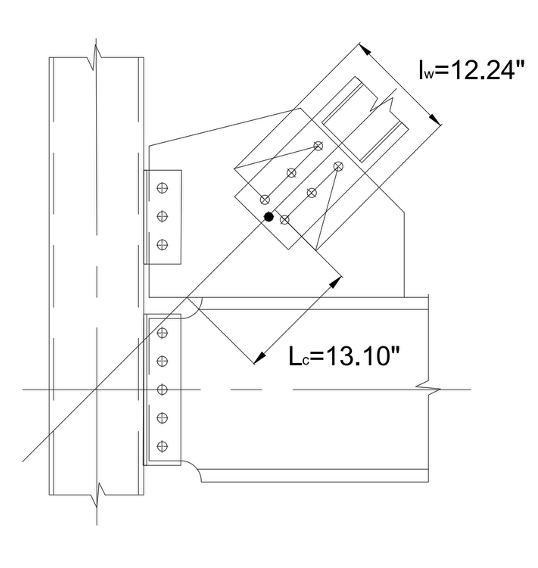
From AISC Manual Part 9, the width of the Whitmore section is:
lw = 3 in.+2[2(4 in.)tan30°] (from Manual. Fig. 9-1a)
= 12.24 in.
The splice plate is eccentric to the gusset plate and can move laterally. Therefore, the effective length is given as K = 1.2 by AISC Design Guide 24. The unbraced length (Lc) of the gusset plate is taken along the center line of the brace. The Whitmore section and unbraced length are shown in Figure 3, in accordance with Figure 12 Case A of Thornton and Lini (2011).
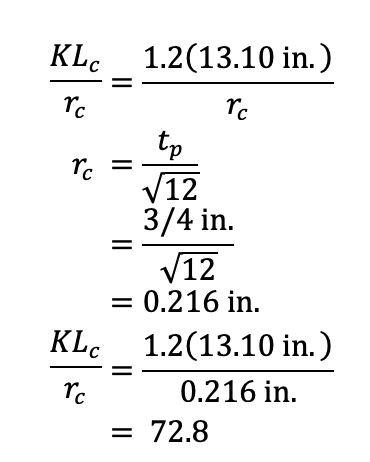
Using AISC Manual Table 4-14 for Fy = 50 ksi and the calculated 𝐾𝑙/𝑟, the available critical stress is:
ϕFn =30.6 ksi
The available flexural buckling strength of a gusset plate in compression is determined from AISC Specification Section E3.
The available flexural buckling strength of a gusset plate in compression is determined from AISC Specification Section E3.
ϕPn = ϕFnAg (from Spec. Eq. E3-1)
= 0.9(30.6 ksi)(12.24 in.)(3/4 in.)
= 280.9 kips
The eccentricity of the splice plate with respect to the gusset plate is:
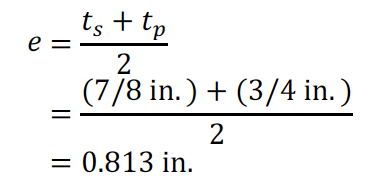
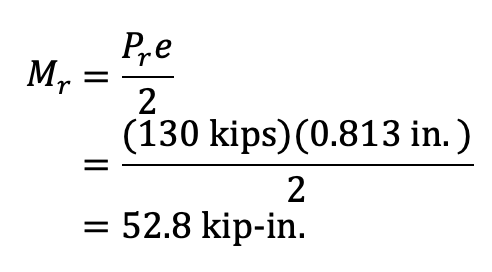
Therefore, the moment acting on the gusset plate is:
The available strength of a gusset plate in flexure is determined from AISC Specification Section F11.
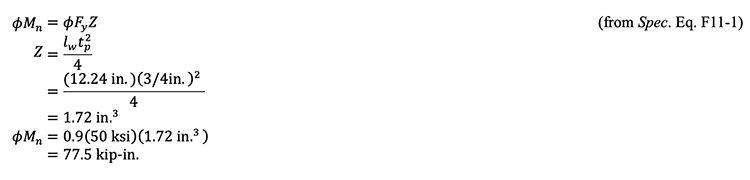
From AISC Design Guide 24 the interaction of the axial force and moment acting on the splice plate is expressed as:

“Buckling” of the splice plate
HSS connections with lapped splice plates are susceptible to forming plastic hinges in the gusset plate and splice plate on either side of the overlap, creating a failure mechanism (Tremblay & Davaran, 2020). Therefore, the moment demand due to the splice-to-gusset plate eccentricity must be considered in the splice plate.
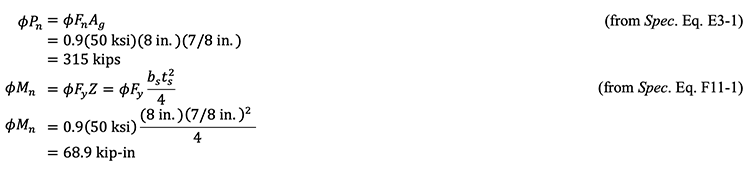
From AISC Design Guide 24 the interaction of the axial force and moment acting on the splice plate is expressed as:

Strength of the fillet welds between the gusset plate and the wide-flange
For the gusset plate to be in equilibrium, Vrb and Hrb act at the gusset plate to wide-flange interface at α=13.25 in. from the column face. The 10 in. weld is centered about this point, therefore the resultant force acts with no eccentricity to the weld. From AISC Specification Section J2.4, the available weld strength, per unit length, is:

From the AISC Specifications Table J2.4 the minimum weld size is 3/16 in. Therefore, a 1/4 in. size is sufficient.
Tensile yielding of the coped wide-flange web
The available strength of the coped wide-flange web for the limit state of tensileyielding is given by AISC Specification Section J4.1(a).
ϕRn = ϕFyAg (from Spec. Eq. J4-1)
= 0.90(50 ksi)(15 in.)(0.730 in.)
= 492.8 kips > 25.1 kips o.k.
Tensile rupture of the coped wide-flange web
The available strength of the coped wide-flange web for the limit state of tensileyielding is given by AISC Specification Section J4.1(a).
ϕRn = ϕFuAe (from Spec. Eq. J4-2)
Where Ae is defined as by AISC Specification Section D3, and is equal to 1.0 (Spec. Table D3. 1) for a load transmitted directly into the cross-section by fasteners.
An =Ag – 5(dh + 1/16 in.)tp
= (15 in.)(0.730 in.) – 5(15/16 in. + 1/16 in.)(0.730in.) (dh from Spec. B3.3(b) and Table J3.3)
=7.30 in.2
Ae = AnU (from Spec. Eq. D3-1)
= 7.30 in.2
ϕRn = 0.75(65 ksi)(7.30 in.2)
= 355.9 kips > 25.1 kips o.k.
Shear yielding of the coped wide-flange web
The available strength of the coped wide-flange web for the limit state of shear yielding at the connection is given by AISC Specification Section J4.2(a). The coped wide-flange web must resist the Vrb and the beam shear.
ϕRn = ϕ0.60FyAgv (from Spec. Eq. J4-3)
= 1.00(0.60)(50 ksi)(15 in.)(0.730 in.)
= 328.5 kips > 209.0 kips o.k.
Shear rupture of the coped wide-flange web
The available strength of the coped wide-flange web for the limit state of shear rupture at the connection is given by AISC Specification Section J4.2(b). The coped wide-flange web must resist the Vrb and the beam shear.
ϕRn = ϕ0.60FuAnv (from Spec. Eq. J4-4)
= 0.75(0.60)(65 ksi)[15 in. – 5(15/16 in. + 1/16 in.)](0.730 in.)
= 213.5 kips > 209.0 kips o.k.
Strength of the bolts between the clip angles and gusset plate
The available shear strength of a 7/8 in. Group 150 bolt (condition N) subject to double shear is given as 61.3 kips per bolt in Table 7-1 of the AISC Manual.
The available strength of the bolts in bearing is given by AISC Specification Section J3.11, assuming deformation at service load is a design consideration.
ϕRn = ϕ2.4dtFu (from Spec. Eq. J3-6a)
= 0.75(2.4)(7/8 in.)(2)(3/8 in.)(65 ksi)
= 76.7 kips/bolt
The available tearout strength of the clip angles at the interior bolt due to vertical force components is determined from AISC Specification Section J3.11.
ϕRn = ϕ1.2lctFu (from Spec. Eq. J3-6c)
lc = s – dh
= 3 in. – 15/16 in.
= 2.06 in.
ϕRn = 0.75(1.2)(2.06 in.)(2)(3/8 in.)(65 ksi)
= 90.5 kips/bolt
The available tearout strength of the clip angles at the exterior bolt due to vertical force components is determined from AISC Specification Section J3.11.
ϕRn = ϕ1.2lc tFu (from Spec. Eq. J3-6c)
lc =le – dh/2
= 2 in.-(15/16 in.)/2
= 1.53 in.
ϕRn = 0.75(1.2)(1.53 in.)(2)(3/8 in.)(65 ksi)
= 66.2 kips/bolt
Therefore, the strength of this bolt group is governed by bolt shear. The 3 bolts connecting the clip angles to the gusset plate must resist Vrc acting at the eccentricity of ex, from the column face, and Hrc acting at the bolt centroid.
ex = 2 in.
From the AISC Manual Table 7-6, the effective number of bolts (C) for a 3-bolt group with an eccentricity of 2.0 in. and an angle of 0° relative to the force is 2.23.
The total utilization of this bolt group is:

Bolt spacing requirements are satisfied per the Strength of the bolts between the splice plate and gusset plate check.
Strength of the bolts between the clip angles and wide-flange section web
As per the Strength of the bolts between the clip angles and gusset plate check the strength of this bolt group is governed by bolt shear, except for the exterior bolt. The exterior bolt may be governed by bolt tearout:
ϕRn =ϕ1.2lctFu (from Spec. Eq. J3-6c)
lc =le – dh/2
= 1.5 in. – (15/16 in.)/2
= 1.03 in.
ϕRn = 0.75(1.2)(1.03 in.)(0.730 in.)(65 ksi)
= 44.0 kips/bolt
The 5 bolts between the clip angles and wide-flange web must resist the resultant load from Vrb and Hrb, the 160 kip beam shear force, and the 91.9 kip beam axial force. Vrb acts at an eccentricity ex=2.0 in. from the bolt group. The remaining forces act on the bolt centroid with the following magnitude:
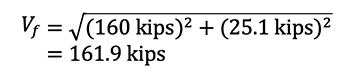
From the AISC Manual Table 7-6, the effective number of bolts (C) for a 5-bolt group with an eccentricity of 2.0 in. with an angle of 0° relative to the force is 4.39. Therefore, the total utilization of this bolt group is:

Bolt spacing requirements are satisfied per the Strength of the bolts between the splice plate and gusset plate check.
Shear yielding of the clip angles
The available strength of the four clip angles for the limit state of shear yielding is given by AISC Specification Section J4.2(a).
ϕRn = ϕ0.60FyAgv (from Spec. Eq. J4-3)
The angles between the column and gusset plate must resist Vrc:
Agv = 2Lata
= 2(10 in.)(3/8 in.)
= 7.5 in.2
ϕRn = 1.00(0.60)(50 ksi)(7.5 in.2)
= 225 kips > 42.9 kips o.k.
The angles between the column and beam web must resist the beam shear and Vrb:
Agv = 2Lata
= 2(16 in.)(3/8 in.)
= 12.0 in.2
ϕRn = 1.00(0.60)(50 ksi)(12.0 in.2)
= 360.0 kips > 209.0 kips o.k.
Shear rupture of the clip angles
The available strength of the four clip angles for the limit state of shear rupture is given by AISC Specification Section J4.2(b).
ϕRn = ϕ0.60FuAnv (from Spec. Eq. J4-4)
The angles between the column and gusset plate must resist Vrc:
Anv = Agv – 3(15/16 in.+1/16 in.)(2)(3/8 in.)
=5.25 in.2
ϕRn = 0.75(0.60)(65 ksi)(5.25 in.2)
= 153.6 kips > 42.9 kips o.k.
The angles between the column and beam web must resist the beam shear and Vrb:
Anv =Agv – 5(15/16 in.+1/16 in.)(2)(3/8 in.)
= 8.25 in.2
ϕRn = 0.75(0.60)(65 ksi)(8.25 in.2)
= 241.3 kips > 209.0 kips o.k.
Block shear of the clip angles
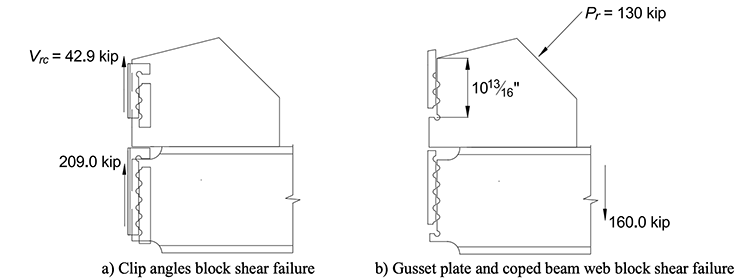
The available strength of the four clip angles for the limit state of block shear is given by AISC Specification Section J4.3 where Ubs is 1.0 for a uniform load. The block shear pattern is shown in Figure 4-a.
ϕRn = ϕ0.60FuAnv + ϕUbsFuAnt ≤ ϕ0.60FyAgv + ϕUbsFuAnt (from Spec. Eq. J4-5)
Agv = 2(16 in. – 2 in.)(3/8 in.) + 2(10 in. – 2 in.)(3/8 in.)
= 16.50 in2.
Anv =Agv – [8 – 2(0.5)](15/16 in. + 1/16 in.)(2)(3/8 in.)
= 11.25 in2.
Ant = 2[(2 in.)2(3/8 in.) – 0.5(15/16 in. + 1/16 in.)2(3/8 in.)]
= 2.25 in2.
ϕRn = 0.75(0.60)(65 ksi)(11.25 in2.) + 0.75(1.0)(65 ksi)(2.25 in2.)
≤ 0.75(0.60)(50 ksi)(16.5 in2.) + 0.75(1.0)(65 ksi)(2.25 in2.)
= 438.8 kips ≤ 480.9 kips
= 438.8 kips > 251.9 kips o.k.
Block shear of the beam web and gusset plate
The available strength of the beam web and gusset plate for the limit state of block shear is given by AISC Specification Section J4.3 where Ubs is 1.0 for a uniform load. The block shear pattern is shown in Figure 4-b.
ϕRn = ϕ0.60FuAnv + ϕUbsFuAnt ≤ ϕ0.60FyAgv + ϕUbsFuAnt (from Spec. Eq. J4-5)
Agv = (15 in. – 1.5 in.)(0.730 in.) + (10 – 13/16)(3/4 in.)
= 18.0 in2.
Anv = Agv – 4.5(15/16 in. + 1/16 in.)(0.730 in.) – 2.5(15/16 in. + 1/16 in.)(3/4 in.)
= 12.8 in2.
Ant = [1.5 in. – 0.5(15/16 in. + 1/16 in.)](0.730 in.) + [1.5 in. – 0.5(15/16 in. + 1/16 in.)](3/4 in.)
= 1.48 in2.
ϕRn = 0.75(0.60)(65 ksi)(12.8 in2.) + 0.75(1.0)(65 ksi)(1.48 in2.)
≤ 0.75(0.60)(50 ksi)(18.0 in2.) + 0.75(1.0)(65 ksi)(1.48 in2.)
= 446.6 kips ≤ 477.2 kips
= 446.6 kips > 251.9 kips o.k.
Shear of the weld metal at the column
The welds between the four clip angles and the column are at an eccentricity (ex) to the bolt group centerline:
ex = 2 in.
The two clip angles between the gusset plate and column must resist Vrc and Hrc (Lw = 10 in.). From the AISC Manual Table 8-4, Coefficients, C, for Eccentrically Loaded Weld Groups (Angle = 0°), C=3.51. The weld size is 3/16 in. which means D = 3 (number of sixteenths-of-an-inch in the fillet weld size).

The two clip angles between the beam web and column must resist Vrb, Hrc, and the beam shear (Lw = 16 in.). From the AISC Manual Table 8-4, Coefficients, C, for Eccentrically Loaded Weld Groups (Angle = 0°), C=3.70. The weld size is 5/16 in. which means D = 5.

From the AISC Specifications Table J2.4 the minimum weld size is 3/16 in. Therefore, both weld sizes are sufficient.
Plastification of the HSS column sidewall
The available strength of the HSS column connecting face can be obtained from ASIC Design Guide 24, Table 9-2, by considering the footprint of two angles as being equivalent to the footprint of a rectangular branch in an HSS-to-HSS T-connection. Per Table 9-2A, only Limit State 1: Chord Plastification, applies, since β = 0.675. In general, additional limit states per Table 9-2A may need to be considered for connections with different geometric parameters.
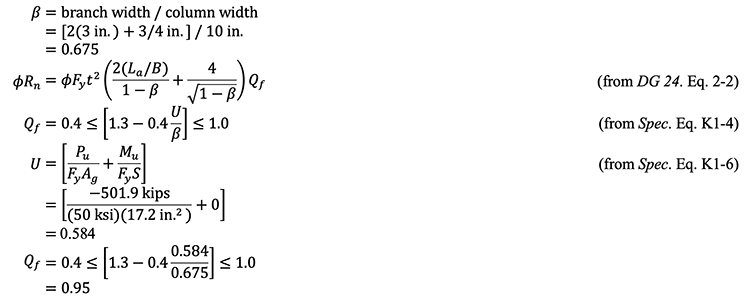
The two clip angles between the gusset plate and the column must resist Hrc.

The two clip angles between the beam web and the column must resist Hrc.

Limits of Applicability (from DG 24. Table. 9-2A):
HSS wall slenderness: B/t or H/t = 10 in. / 0.464 in. = 22 ≤ 40 o.k.
Material strength: Fy = 50 ksi ≤ 52 ksi o.k.
Ductility: ASTM A500/A500M Grade C is acceptable
Assume the end distance is greater than 
The following limit states must also be checked if the brace is in tension:
Splice plate tensile yielding
The available strength of the slotted splice plate for the limit state of tensile yielding is given by AISC Specification Section J4.1(a).
ϕRn = ϕFyAg (from Spec. Eq. J4-1)
= 0.90(50 ksi)(8 in.)(7/8 in.)
= 315.0 kips > 130 kips o.k.
Splice plate tensile rupture (of whole cross section)
The available strength of the slotted splice plate for the limit state of tensile rupture is given by AISC Specification Section J4.1(b).
ϕRn = ϕFuAe (from Spec. Eq. J4-2)
where 𝐴e is defined as 𝐴n𝑈 by AISC Specification Section D3, and 𝑈 is equal to 1.0 (Spec. Table D3. 1) for a load transmitted directly into the cross-section by fasteners.
An = Ag – 2(dh + 1/16 in.) tp (dh from Spec. J3.3(b) and Table J3.3)
= (8 in.)(7/8 in.) – 2(15/16 in. + 1/16 in.)(7/8 in.)
= 5.25 in2.
Ae = AnU (from Spec. Eq. D3-1)
=5.25 in.2
ϕRn = 0.75(65 ksi)(5.25 in.2 )
= 255.9 kips > 130 kips o.k.
Splice plate block shear failure
The available strength of the splice plate for the limit state of block shear is given by AISC Specification Section J4.3.
1. One viable failure pattern consists of a shear failure along the welds and a tensile failure between the edge of the brace and edge of the plate where Ubs is 1.0 for a uniform load.
ϕRn = ϕ0.60FuAnv + ϕUbsFuAnt ≤ ϕ0.60FyAgv + ϕUbsFuAnt (from Spec. Eq. J4-5)
Agv = 2(6 in.)(7/8 in.)
= 10.5 in2.
Anv = Agv
Ant = (8 in. – 6 in.)(7/8 in.)
= 1.75 in2.
ϕRn = 0.75(0.60)(65 ksi)(10.5 in2.) + 0.75(1.0)(65 ksi)(1.75 in2.)
≤ 0.75(0.60)(50 ksi)(10.5 in2.) + 0.75(1.0)(65 ksi)(1.75 in2.)
= 392.4 kips ≤ 321.6 kips
= 183.7 kips > 130 kips o.k.
2. Another viable failure pattern consists of a shear failure between the 6 bolt holes and the plate end, with a tensile failure between one pair of bolts where Ubs is 1.0 for a uniform load.
ϕRn = ϕ0.60FuAnv + ϕUbsFuAnt ≤ ϕ0.60FyAgv + ϕUbsFuAnt (from Spec. Eq. J4-5)
Agv = 2(4 in. + 4 in. + 2 in.)(7/8 in.)
= 17.5 in2.
Anv = Agv – 2(2.5)(15/16 in. + 1/16 in.)(7/8 in.)
= 13.12 in2.
Ant = (3 in.)(1/2 in.) – (15/16 in. + 1/16 in.)(7/8 in.)
= 1.75 in2.
Since Agv, Anv, and Ant of failure pattern 2 are greater than or equal to those of failure pattern 1, it is not critical.
Gusset plate block shear failure
ϕRn = ϕ0.60FuAnv + ϕUbsFuAnt ≤ ϕ0.60FyAgv + ϕUbsFuAnt (from Spec. Eq. J4-5)
Agv = 2(4 in. + 4 in. + 1.5 in.)(3/4 in.)
= 14.3 in2.
Anv =Agv – 2(2.5)(15/16 in. + 1/16 in.)(3/4 in.)
= 10.5 in2.
Ant = (3 in.)(3/4 in.) – (15/16 in. + 1/16 in.)(3/4 in.)
= 1.5 in2.
ϕRn = 0.75(0.60)(65 ksi)(10.5 in2.) + 0.75(1.0)(65 ksi)(1.5 in2.)
≤ 0.75(0.60)(50 ksi)(14.3 in2.) + 0.75(1.0)(65 ksi)(1.5 in2.)
= 380.2 kips ≤ 394.9 kips
= 380.2 kips > 130 kips o.k.
HSS brace tensile yielding
The available strength of the HSS brace for the limit state of tensile yielding is given by AISC Specification Section D2.(a).
ϕPn = ϕFyAg (from Spec. Eq. D2-1)
= 0.90(50 ksi)(7.58 in.2)
= 341.1 kips > 130 kips o.k.
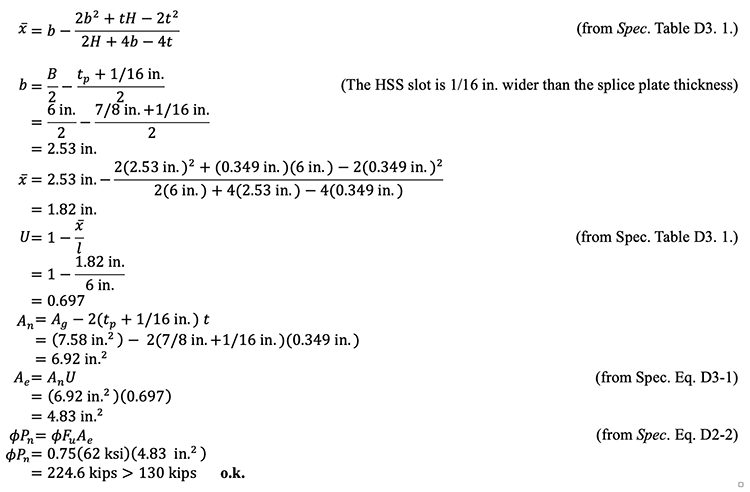
HSS brace tensile rupture (circumferential fracture of the whole cross section)
The available strength of the HSS brace for the limit state of tensile rupture is given by AISC Specification Section D2.(b), where 𝐴e is defined as 𝐴n𝑈 by AISC Specification Section D3, and 𝑈 is defined in Spec. Table D3. 1.
HSS brace block shear failure (tear out beside the fillet welds)
The available strength of the HSS brace for the limit state of block shear is given by AISC Specification Section J4.3 where Ubs is 1.0 for a uniform load.
ϕRn = ϕ0.60FuAnv + ϕUbsFuAnt ≤ ϕ0.60FyAgv + ϕUbsFuAnt (from Spec. Eq. J4-5)
Agv = 4(6 in.)(0.349 in.)
= 8.38 in2.
Anv = Agv
Ant = 0 (assumed no welding is performed at the end of the splice plate)
ϕRn = 0.75(0.60)(62 ksi)(8.38 in2 ) ≤ 0.75(0.60)(50 ksi)(8.38 in2.)
= 233.8 kips ≤ 188.6 kips
= 188.6 kips > 130 kips o.k.
The only force which changes in magnitude from Figure 2 to Figure 5 due to the reversal of the brace axial force is the vertical reaction on the bottom of the column. The column compressive force decreases and therefore has a conservative effect on the chord stress function (U) in the Plastification of the HSS column sidewall limit state.
References
AISC. (2022). Specification for Structural Steel Buildings, AISC 360-22, American Institute of Steel Construction, Chicago, IL.
AISC. (2023). Steel Construction Manual, 16th. Edition, American Institute of Steel Construction, Chicago, IL.
Dranger, S. T., & Thornton, A. W. (2025). A Derivation of the Uniform Force Method for Analysis and Design of Gusset Plate Connections for Vertical Diagonal Bracing, Engineering Journal, 2nd. quarter, American Institute of Steel Construction, Chicago, IL.
Packer, J. A., & Olson, K. (2024). Hollow Structural Section Connections, AISC Design Guide No. 24, 2nd. edition, American Institute of Steel Construction, Chicago, IL.
Thornton, W.A., & Lini, C. (2011). The Whitmore Section – How to Use the Whitmore Method for Tension and Compression Strength Checks, Modern Steel Construction, July Issue, American Institute of Steel Construction, Chicago, IL.
Tremblay, R., & Davaran, A. (2020). Design of Bolted Single Shear Lap Connection with Different Thicknesses of Splice Plates, Journal of Structural Engineering, March Issue, American Society of Civil Engineers, Reston, VA.