
HSS Moment Connection Design Examples: Transverse Flange Plates
By Mike Manor, PE, MLSE
Technical Consultant, Steel Tube Institute
July, 2025
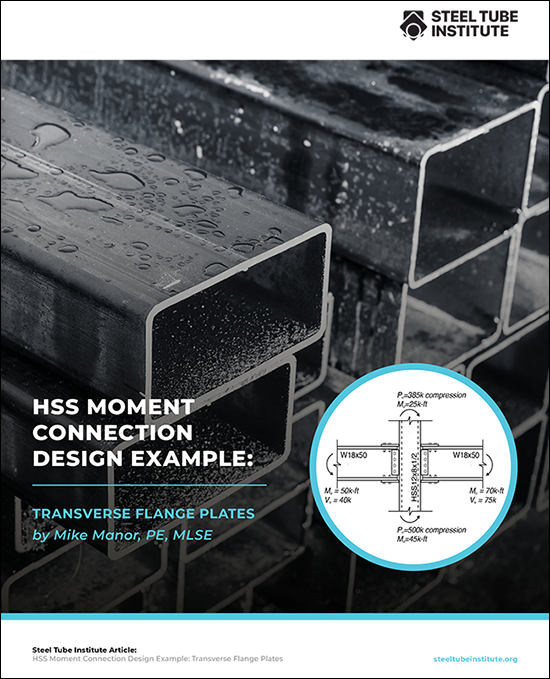
This article provides an in-depth design example for a common moment connection between a wide flange beam and an HSS column using plates above and below the beam to transfer the moment. Determining the capacity for this connection requires the calculation of several limit states, as well as load interactions, that are unique to HSS members. While this connection is prevalent in practice, detailed design examples are rarely available.
The following example navigates the winding path through the AISC 360-22 Steel Specification and AISC 16th Edition Steel Manual provisions to illustrate the design of a transverse plate HSS moment connection. For guidance on designing the shear tab connection between the wide flange beams and the HSS column, please refer to these resources:
- STI HSS Design Manual Volume 3: Connection at HSS Members
- STI HSS Shear Connections Webinar (November 2022)
Example: Flange Plate Moment Connection
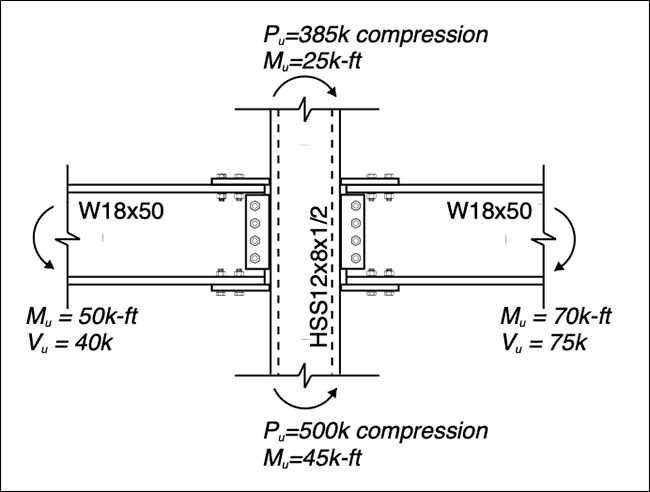
Given
- HSS material: ASTM A500 Gr. C
(Fy = 50 ksi, Fu = 62 ksi) - Column: HSS 12x8x1/2
- Wide Flange Material: ASTM A992
(Fy = 50 ksi, Fu = 65 ksi) - Beams: W18x50
- Plate Material: ASTM A572
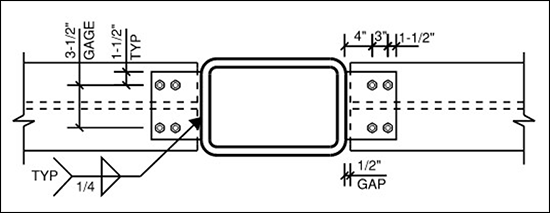
(Fy = 50 ksi, Fu = 65 ksi) - Plate: PL 3/8 x 6 1/2 in
- Weld Electrodes: FEXX = 70 ksi
- Weld Size: 1/4” fillet weld top and bottom of each plate
- Bolts: (4) 3/4 in A325-N (Group 120) with STD holes at 3 in spacing and 3 ½ in gage installed snug tight
- Distance from plate to end of HSS member is sufficient to develop the full connection capacity
Verify the capacity of the moment connection is adequate for the loads and geometry.
Material Strength
Chord: HSS Column Fy = FyHSS = 50 ksi
Branch: Transverse Plate Fyb = Fy,pl = 50 ksi
Beam: Wide Flange Fy,wf = 50 ksi
Connection Geometry
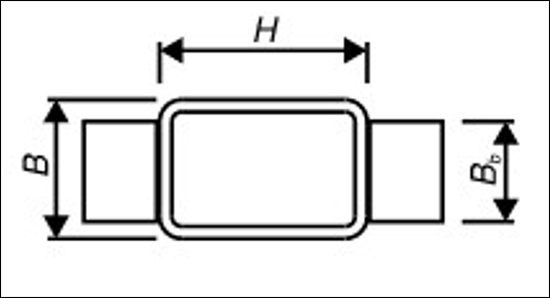
Chord: HSS12x8x1/2 Column
B = 8 in H = 12 in

Cross-Sectional Area Ag = 17.2 in2
Section Modulus Sx = 55.6 in3 Sy = 44.4 in3
Branch: Transverse Plate
tb = tplate = 0.375 in Bb = Bplate = 6.50 in

Beam: W18x50
d = 18.0 in bf = 7.50 in tf = 0.570 in
Plate Loads at HSS Column
The basic flow of forces for flange plate moment connections is for the moment load to be split into a force couple with a tension load at one flange and a compression load at the other. In this example, the bolts transfer the forces from the beam flanges to the flange plates. The flange plates in turn apply a force through welds to the HSS column face as a transverse plate connection. Since there are two beams with flange plates on opposite sides of the column, this configuration is a cross-connection.

Limits of Applicability
Connections involving HSS members must be designed to the limit states in the AISC 360-22 Specification, Chapters J and K (see “HSS Limits of Applicability” for additional information). The design equations for the connection limit states required specifically for HSS in Chapter K have limited ranges, called the Limits of Applicability (LOA), within which the design equations are valid. These LOA are based on material strength and connection geometry, which were set by the parameters used in the research studies that developed these equations. Outside the bounds of the range limits, the Chapter J equations are not necessarily invalid, however the research did not extend beyond the given parameters.
For the current example, most of the limit state requirements are provided in Chapter J, which covers steel connections more generally for all steel shapes. The Chapter J limit state equations were empirically derived and thus are valid in nearly all cases without limits of applicability. However, there are a few exceptions when using some of the Section J10 equations for HSS connections with webs subject to concentrated loads. These equations include a reduction factor, Qf which can affect the HSS connection capacity, and it accounts for the interaction of the applied force with the axial stress in the chord member (discussed in the next section). The Qf factor has its own set of LOA for validity which are checked below and discussed in the next section. Following are the relevant limits of applicability from Section K1.3 and AISC 16th Edition Manual page 9-17 for using the Qf factor pertinent to this example.

All limits of applicability are satisfied for this connection, and the connection limit state design equations are valid for this connection.
Chord-Stress Interaction Parameter
The chord-stress interaction parameter, Qf, is defined in Specification Section K1.3. The Qf parameter represents the interaction of the axial stress in the HSS chord face at the connection (expressed through the chord utilization ratio, U) and the perpendicular load, Pu, from the branch member. When this perpendicular force is applied to the face of the HSS chord, it can lead to localized P-δ effects if the column face is under net compression, reducing the available connection capacity associated with certain limit states. Additionally, the ratio of the branch to chord width, β, influences the interaction. Thus, high levels of compressive stress in the HSS wall face and/or small β values lead to values of Qf < 1.0 which means there is a reduction in the connection capacity. In contrast, when the HSS chord face at the connection is in net tension, P-δ effects are not a concern and Qf = 1.0.
Since the column in this example is loaded with both axial compression and bending moment, the column must be investigated to determine if the stress interaction is high enough to reduce the connection strength. AISC 360-22 Section K1.3(c)(1) provides the calculation of Qf for a rectangular HSS transverse plate connection. The axial force from the combined loading must be considered to determine if there is net tension or compression at the location of the normal force from the transverse plate. This example has plate connections on both sides of the column, and at least one side (if not both) will have net compression in the column. Therefore, this example will focus on the additive compression for determining the Qf factor.

For rectangular HSS, load values must be taken on the side of the connection with the higher compression stress. In this case, it is the bottom side of the connection where all the vertical compression loads accumulate.
Pro = Pu = 385 k + 40 k + 75 k = 500 k
Mro = Mu = Mu,top + Mu,right – Mu,left = 25 k ∙ ft + 70 k ∙ ft – 50 k ∙ ft = 45k ∙ ft
Fc = Fy for LRFD

Chord Stress Interaction Parameter, Qf

Limit States for HSS Connection Design

There are many limit states for determining the strength for connections to HSS members throughout Chapters J and K in the AISC 360-22 Specification. Knowing which limit states apply in each situation and how to properly apply the equations to each situation is not always straightforward. To help with this task, STI has a document available called “Limit State Tables” as a free download, which provides a road map to help navigate each connection case. For this example, the axial load table A3 is applicable using the column under the heading “Transverse Plate T- and Cross-Connections.” As visible in Figure 1, the flange plates transferring the moment from the wide flange beams to the HSS column are on opposite sides of each other and thus is labeled as a cross-connection.
The Limit State Tables also provide references to the design equations in the AISC 360-22 Specification and AISC Design Guide 24. In some limit states, AISC Design Guide 24 provides equations with alternative forms, which the Limit States Tables show in blue text. For this example, all equations used will be referenced from the AISC 360-22 Specification. Note that some of the equations in the specification were originally developed for wide flange shapes and that some substitutions are required to adapt the equations for use with HSS members. Therefore, all equations will be presented first in the original form directly from the specification and all pertinent substitutions will follow.
The limit states pertinent to this example are split into three sections. The first section will be the limit states that apply to the transverse plate at the interface with the HSS column. The second section focuses on the limit states applicable only to the HSS column. The last section covers the transfer of forces between the wide flange beam and the flange plates. Note that the flange plates are the same as the transverse plates, and the two different terms are used for the two different functions that the plates serve at each end. This maintains consistency with plate connections at both HSS and wide flange members while helping categorize the connection limit states. The two different terms are used for the two different functions that the plates serve for consistency with plate connections at both HSS and wide flange members while categorizing the connection limit states at opposite ends of the plates.
1. Transverse Plate Limit States

When connecting steel plate elements transverse to the longitudinal direction of an HSS member with an axial load, the wall of the HSS resists the load as if it were a “beam” spanning between the two sidewalls. Since the HSS walls are continuous around the corner, there is fixity at the end of the “beam.” The stiffness along this “beam” varies along its length with most of the stiffness closer to the sidewalls than in the middle. The stiffer portions will then resist a higher portion of the axial load from the transverse plate, resulting in an uneven distribution of the axial load and higher stress at the edges of the transverse plate. Due to this, only an effective width of the plate is typically considered for limit states, such as yielding, to simplify the calculations. For information about this phenomenon, see the following two STI articles: “Understanding Local Yielding Due to Uneven Load Distribution” and “Transverse Plate-to-Square/Rectangular HSS Connections.”
There are two different effective widths to calculate for transverse plate elements. The first is the effective width for the branch plate element itself, Be, for distribution of the stress through yielding in the branch element(s). The effective width is based on the interaction of the steel yield strengths and the thicknesses for both the branch transverse plate and the HSS wall. The second effective width, Bep, is for shear strength of the HSS chord wall alone to prevent the plate from punching through the wall. Since the branch transverse plate does not affect the punching shear strength of the HSS column/chord wall, the interaction portion of the equation was removed.

DG24, 2nd Ed.
In both calculations, the effective width cannot be larger than the actual width of the transverse plate. See also AISC 360-22 Commentary Table C-K1.1 and AISC Design Guide 24 for additional information. To simplify the process, STI has a tool available for engineers called the Effective Weld Length Calculator that calculates the effective weld length per Table K5.1. See the accompanying resource to this article that demonstrates how to use the Effective Weld Length Calculator with the transverse plate from this example.
Effective Width for Connection to Rectangular HSS (Local Yielding of Transverse Elements), Be

Effective Width for Connection to Rectangular HSS (Shear Yielding/Punching of HSS chord), Bep

Limit State: Local Tension Yielding of Transverse Plate
Due to the variability of the HSS wall stiffness, the stress in the transverse plate is concentrated toward the sides of the plate rather than the middle. The effective width discussed above is used to determine the transverse plate yielding capacity.
φRn = φFyAg [AISC 360-22 Equation J4-1]
Fy = Fyb = Fy,plate = 50 ksi
Ag = Ae = Betp = 4.68 in * 0.375 in = 1.76 in2
φRn = 0.9 * 50 ksi * 1.76 in2 = 79.1 k
Limit State: Local Compression Yielding of Transverse Plate
This limit state is for the compression in the transverse plate at the interface with the HSS column chord wall rather than for overall buckling of the plate. Therefore, the plate effective width due to uneven load distribution should be used along with the assumption of 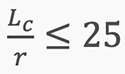 . The plate buckling is checked in the section later in this example for the flange plate to wide flange connection.
φRn = φFyAg [AISC 360-22 Equation J4-6]
Fy = Fyb = Fy,plate = 50 ksi
Ag = Ae = Betp = 4.68 in * 0.375 in = 1.76 in2
φRn = 0.9 * 50 ksi * 1.76 in2 = 79.1 k
Limit State: Effective Weld Length for Plate-to-HSS Weld
When welding the transverse plate to the column, the load only transfers through the effective portions of the plate. Therefore, the same effective plate width for yielding is applicable as an effective weld length. To determine the strength of the weld, use AISC 360-22 Specification section K5 and Table K5.1 with reference to section J2.4 and Table J2.5. Note that equation K5-1 is like equation J2-4 but without the kds factor. The reason the term is left out is the stiffness is not uniform along the weld due to the variable stiffness of the HSS wall, so this case does not satisfy the strain compatibility requirement of section J2.4(a)(1) per the J2.4 user note. Therefore, kds for this case per J2.4(a)(3).
To assist with the calculation of effective weld lengths at HSS members, STI has created a tool called the “HSS Effective Weld Length Calculator” available to members on the STI website.
φRn = φFnwtwle [AISC 360-22 Equation K5-4]
Fnw = 0.6FEXX = 0.6 * 70 ksi = 42 ksi [AISC 360-22 Table J2.5]
le = 2Be = 2 * 4.68 in = 9.37 in [AISC 360-22 Equation K5-4]

φRn = φFnwtwle = 0.75 * 42 ksi * 0.18 in * 9.37 in = 52.2 k
As an alternative calculation for transverse plates, the weld strength can be calculated directly from the AISC 16th Edition Manual as follows:
φRn = (1.392 k/in)Dl [AISC 16th Edition Manual Equation 8-2a]
D = weld size of 1/4″ fillet in sixteenths = 4
l = le = 2Be = 2 * 4.68 in = 9.37 in [AISC 360-22 Equation K5-4]
φRn = (1.392 k/in) * 4 * 9.37 in = 52.2 k
2. HSS Column Limit States
To aid with the calculation of HSS limit states, the STI website contains a tool available to members called “HSS Connex” that can assist in calculating the capacity of the following limit states.
Limit State: Local Yielding of HSS Sidewalls
When a concentrated force is applied to the side of an HSS chord, a localized yielding failure is possible in the region of the sidewall near the force. This yielding can occur from either compressive or tensile forces. In the current example, there are moments with different magnitudes on both sides of the column. This limit state must resist the largest of all concentrated forces present.
φRn = φFywtw(5K + lb) [AISC 360-22 Equation J10-2]
Fyw = Fy,HSS = 50 ksi
tw = 2tdes = 2 * 0.465 in = 0.93 in
lb = tp = 0.375 in
k = corner radius = 1.5tdes = 1.5 * 0.465 in = 0.70 in
φRn = 1.0 * 50 ksi * 0.93 in * (5 * 0.70 + 0.375) = 179.6 k
Limit State: Plastification of the HSS Chord Connecting Face
Plastification is a flexural yielding limit state for a plate member with a tension or compression load applied normal to the plane of the surface. For HSS, the plate member is the connecting wall of the HSS that the branch or transverse plate is attached to. AISC 360-16 Section J10.10 requires that this limit state be checked, and the AISC 16th Edition Manual provides a method of capacity calculation in Part 9 based on yield line theory.

Reference also AISC 16th Edition Manual Figure 9-5(a).
Fy = Fy,HSS = 50 ksi
w = B = 8 in
l = tp = 0.375 in
t = tdes = 0.465 in

Limit State: Shear Yielding (Punching) of the HSS Chord Connecting Face
Shear yielding is a limit state where the branch or transverse plate will “punch” a hole through the HSS wall plate element from either a tension or compression load normal to the surface. AISC 360-16 Section J10.10 requires that this limit state be checked, and the AISC 16th Edition Manual provides a method to calculate the capacity based on the punching shear effective width, Ceff = Bep. See the effective width discussion above.
φRn = 0.6φFytp(2ceff + 2l) [AISC 16th Edition Manual Equation 9-43]
Fy = Fy,HSS = 50 ksi
tp = tdes = 0.465 in
l = tp = 0.375 in
ceff = Bep = 4.68 in
φRn = 0.6 * 1.0 * 50 ksi * 0.465 in * (2 * 4.68 in + 0.375 in ) = 115.9 k
Limit State: Local Crippling of HSS Sidewalls
When the sidewalls of an HSS chord are thin, a compressive load normal to the HSS axis can cause a localized buckling in a rippled wave-like shape. AISC 360-22 Section J10.3 provides a capacity that was developed for wide flanges but is adapted for use with HSS. The capacity of both sidewalls contributes to the total capacity.

Fyw = Fy,HSS = 50 ksi
tw = tf = tdes = 0.465 in
d = H = 12 in
lb = tp = 0.375 in

Limit State: Local Buckling of HSS Sidewalls
This limit state is required when there are two compressive forces on opposite sides of the HSS member at the same location as is the case in this example from the moment force couple at the bottom transverse plates. These opposing concentrated loads can cause a buckling failure in the sidewalls for higher width-to-thickness ratios. Since HSS members have two sidewalls, the limit state capacity for a single sidewall is doubled.
This example has a larger moment from the right-side beam than the left-side beam, and thus the transverse plate compressive force is different on each side of the column. Therefore, this limit state only needs to resist the lower of the two compressive forces.

Fy = Fy,HSS = 50 ksi
tw = tdes = 0.465 in
h = H – 3tdes = 12 in – 3 * 0.465 in = 10.61 in

HSS Sidewall Limit State Notes
The three sidewall limit states (Local Yielding, Local Crippling, and Local Buckling) for HSS are noted in AISC Design Guide 24 as more likely to control in some geometric conditions than others. Therefore, guidance is provided in Design Guide 24 for suggested ranges as to when each limit state should be checked. However, for the purposes of this example, all limit states were checked. From a practical standpoint, there are many cases in which the capacity of certain limit states is significantly higher than others and can be considered non-governing based on engineering judgment.
3. Flange Plate Connection Limit States
The compression and shear load in the beam flanges from the force couple need to be transferred by the beam flange, bolt group, and flange plate. All the limit states are covered in the general connection provisions of AISC 360-22 Chapter J without influence from the HSS column.
Limit State: Bolt Shear
φRn = nφrn [AISC 16th Edition Manual Table 7-1]
φRn = 17.9 k/bolt
n = 4 bolts
φRn = 4 * 17.9 k/bolt = 71.6k
Limit State: Bolt Bearing and Tearout at Beam Flange
Bolt Bearing: φRn = φ2.4dtFu [AISC 360-22 Equation J3-6a]
d = 0.75 in bolt diameter
t = tf = 0.57 in
Fu = Fu,beam = 65 ksi
φRn = 0.75 * 2.4 * 0.75 in * 0.57 in * 65 ksi = 50 k/bolt
Bolt Tearout: φRn = φ1.21ctFu [AISC 360-22 Equation J3-6c]

lc,typ bolt = lspacing – dbolt hole = 3 in – 0.8125 in = 2.19 in
φRn,end bolt = 0.75 * 1.2 * 3.09 in * 0.57 in * 65 ksi = 103.2 k/bolt
φRn,typ bolt = 0.75 * 1.2 * 2.19 in * 0.57 in * 65 ksi = 72.9 k/bolt
For all bolts, the bearing value controls over the tearout, thus
φRn,total = 4 * 50.0 k/bolt = 200 k
Limit State: Bolt Bearing and Tearout at Flange Plate
Bolt Bearing: φRn = φ2.4dtFu [AISC 360-22 Equation J3-6a]
d = 0.75 in bolt diameter
t = tp = 0.375 in
Fu = Fu,bplate = 65 ksi
φrn = 0.75 * 2.4 * 0.75 in * 0.375 in * 65 ksi = 32.9 k/bolt
Bolt Tearout: φRn = φ1.21ctFu [AISC 360-22 Equation J3-6c]
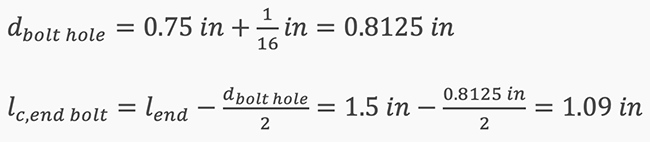
lc,typ bolt = lspacing – dbolt hole = 3 in – 0.8125 in = 2.19 in
φrn,end bolt = 0.75 * 1.2 * 1.09 in * 0.375 in * 65 ksi = 24.0 k/bolt
φrn,typ bolt = 0.75 * 1.2 * 2.19 in * 0.375 in * 65 ksi = 48 k/bolt
Tearout controls for the end bolts and bearing controls for the typical bolts, thus

Limit State: Block Shear at Beam Flange
φRn = φ(0.6FuAnv + UbsFuAnt) ≤ = φ(0.6FyAgv + UbsFuAnt) [AISC 360-22 Equation J4-5]
Agv = 2 * 0.57 in * (3.5 in + 3 in) = 7.4 in2

Agt = 0.57 in * (7.5 in – 3.5 in) = 2.28 in2

φRn, total = 0.75 * (0.6 * 65 ksi * 5.91 in2 + 1.0 * 65 ksi * 1.78 in2) = 259.8 k
φRn, max = 0.75 * (0.6 * 50 ksi * 7.4 in2 + 1.0 * 65 ksi * 1.78 in2) = 253.6 k

Limit State: Block Shear at Flange Plate U-shape
φRn = φ(0.6FuAnv + UbsFuAnt) ≤ = φ(0.6FyAgv + UbsFuAnt) [AISC 360-22 Equation J4-5]
Agv = 2 * 0.375 in * (1.5 in + 3 in) = 3.38 in2

Agt = 0.375 in * (3.5 in) = 1.31 in2

φRn, total = 0.75 * (0.6 * 65 ksi * 2.39 in2 + 1.0 * 65 ksi * 0.98 in2) = 117.9 k
φRn, max = 0.75 * (0.6 * 50 ksi * 3.38 in2 + 1.0 * 65 ksi * 0.98 in2) = 123.9 k

Limit State: Block Shear at Flange Plate Double L-shape
φRn = φ(0.6FuAnv + UbsFuAnt) ≤ = φ(0.6FyAgv + UbsFuAnt) [AISC 360-22 Equation J4-5]
Agv = 2 * 0.375 in * (1.5 in + 3 in) = 3.38 in2
Agt = 0.375 in * (6.5 in – 3.5 in) = 1.31 in2

φRn, total = 0.75 * (0.6 * 65 ksi * 2.39 in2 + 1.0 * 65 ksi * 0.80 in2) = 108.8 k
φRn, max = 0.75 * (0.6 * 50 ksi * 3.38 in2 + 1.0 * 65 ksi * 0.80 in2) = 114.8 k
Limit State: Flange Plate Tensile Rupture at Bolt Holes
This tension capacity is taken at the location of the bolt holes away from the HSS member where the full cross section area of the plate is effective.
φRn = φFuAe = φFuAnU [AISC 360-22 Equation D2-2]
U = 1.0

φRn = 0.75 * 65 ksi + 1.78 in2 * 1.0 = 86.8 k
Limit State: Flange Plate Compression Buckling
The plate compression capacity is based on the full area of the plate as buckling is independent of the HSS column. Per Section J4.4, the provisions of Chapter E apply when  .
.
φRn = φFnAg [AISC 360-22 Equation D2-2]
Lc = 4 in

φRn = 0.90 * 45.3 ksi + (0.375 in * 6.5 in) = 99.3 k
Controlling Connection Limit States
Transverse Plate: 52.2 K Effective Weld Length for Plate-to-HSS Weld
HSS Column: 96.7 K Plastification
Flange Plate: 71.6 K Bolt Shear
φRn = 52.2 k < 46.7 k axial force OK
Conclusion
In summary, designing moment connections between HSS columns and wide flange beams requires a solid grasp of HSS-specific limit states with careful application of the AISC 36-22 Specification and AISC 16th Edition Steel Manual. The design example demonstrated how to determine the design limits, account for variable stiffness effective widths, and adapt connection design equations for use with HSS members. With a clear understanding of these design concepts and a knowledge of the available tools such as the STI Limit State Tables and the Effective Weld Length Calculator, engineers can efficiently perform the correct limit state calculations and confidently design steel framing with HSS members.
References
STI Article: “Transverse Plate-to-Square/Rectangular HSS Connections” by Jeffrey A. Packer, January 2015
STI Article: “Understanding Local Yielding Due to Uneven Load Distribution” by Mike Manor, February 2021
STI Article: “HSS Limits of Applicability” by Mike Manor, February 2022
AISC Publication: “360-22: Specification for Structural Steel Buildings”
AISC Publication: “Steel Construction Manual 16th Edition”
AISC Publication: “Design Guide 24: Hollow Structural Section Connections (Second Edition)”