
Additive Manufacturing for Tubular Structures
by Jeffrey A. Packer and Ian G. Kennedy
Department of Civil & Mineral Engineering, University of Toronto, Ontario, Canada
May 2026
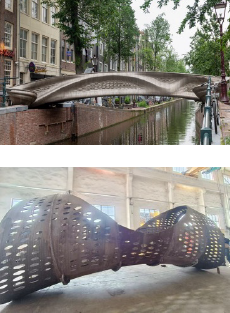
Figure 1: Steel footbridges, entirely produced using WAAM
Additive manufacturing (AM), also known simply as 3D printing, is a digitized procedure that uses a sliced computer-aided design (CAD) model to instruct an automated system to build an object, layer by layer. Fusion-based metal AM uses a high-energy density heat source to melt a metallic feedstock (e.g. a wire or powder) along a pre-programmed route. Wire arc additive manufacturing (WAAM) is a type of fusion-based AM process which typically uses a gas metal arc welding (GMAW) technique, by feeding a consumable wire electrode through an automated welding torch fitted to the end of a robotic arm or gantry system. Thus, this embodiment has also been termed gas metal arc additive manufacturing (GMAAM). WAAM technology, a directed energy deposition (DED) process, has its roots dating back to the 1920s, with major advancements in the 1980s and 1990s (Feldmann et al., 2019). Compared to other metal AM processes (e.g. powder-based AM), WAAM has the advantage of greater build volumes and high deposition rates due to local gas shielding, a material utilization rate nearing 100%, and reduced safety concerns from using a wire feedstock (Paul et al., 2024). Research has now progressed to the point whereby WAAM has been identified as having significant potential for the construction industry.
The first large-scale WAAM application in the construction sector was a footbridge, constructed by the Dutch company MX3D in 2018, to demonstrate the viability of the technology (Figure 1(a)). The stainless-steel bridge was printed in several pieces over a period of six months, then manually welded together. Due to a lack of structural standards for this technology, material, component and full-scale structural testing was carried out, accompanied by modeling, for safety verification (Gardner et al., 2020).
WAAM for HSS
WAAM has been used to produce entire tubular members, in the manner illustrated in Figure 2(a). This is an impractical and far more expensive proposition than using manufactured HSS members, but WAAM tubes have been useful for research purposes in the investigation of behavioral characteristics, material properties, geometric properties and surface finishes (Figure 2(b)), printing defects, residual stresses, and so forth (Gardner et al., 2020; Kyvelou et al., 2021; Huang et al., 2022a; Huang et al., 2022b).

Figure 2: Production of round HSS by WAAM
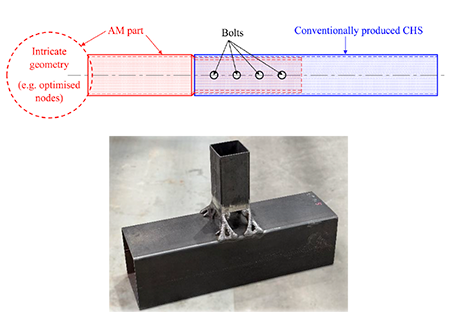
Figure 3: WAAM components for connecting to HSS
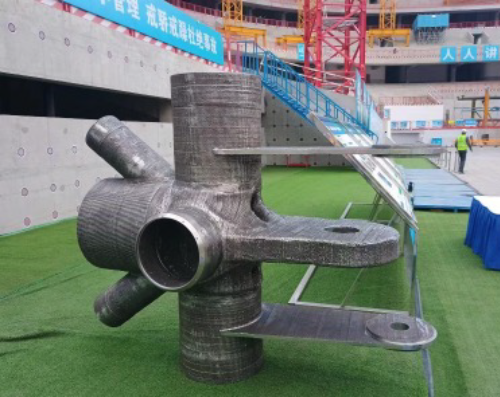
Rather than entire printed members, the niche for WAAM in tubular steel construction has been identified as connection nodes (Figure 2(b)) or as connectors (Figure 3 and Figure 4). The ability to print bespoke, shape-optimized components is also well suited to satisfying architectural whims (Figure 3(b)). These are general attributes associated with steel castings-to-HSS as well, but Figure 4 illustrates an interesting advantage of a WAAM-produced connector for strengthening conventional HSS K-connections. A saddle can be printed, or welded, onto a continuous chord member of uniform size, without cutting the chord, which would be necessary with a cast-steel node. To illustrate the close relationship between casting and AM, a major designer/supplier of cast-steel components for structures in the U.S., Cast Connex®, teamed with Lincoln Electric Additive Solutions (in Euclid, OH) to produce a 36-ft. long pedestrian bridge for NASCC in 2025. This exhibit (Figure 5) utilized WAAM components welded to round HSS and vividly demonstrated the arrival of AM (Binder et al., 2025).


Mechanical Properties
The material characteristics of WAAM components can differ from traditional rolled or cast-steel components, due to their unique manufacturing process. When compared to rolled steel, the strengths of WAAM steel have generally been found to be higher, though less ductility is exhibited (Paul et al., 2024). This is a result of the continuous welding process, as each layer is subjected to heating and cooling cycles, which refines the grain structure and increases the material strength. Consequently, the final mechanical properties of a WAAM part may differ from those of the welding wire, similar to multi-pass welds. Key properties, including the yield stress (YS), ultimate tensile strength (UTS), ductility, and toughness can be established through the destructive testing of samples taken from WAAM parts (e.g. tensile coupon, Charpy V-notch, guided bend; see Figure 6) (Galloway, 2022). In this way, the production procedure for a WAAM component can be “qualified” within a range of operating parameters. However, much like qualified welding procedures, these are not valid outside the specified parametric ranges, as changes to the travel speed, inter-pass temperature, and deposition direction (i.e. consistent vs. reversing) will change the properties of the final component (Galloway, 2022).

Unlike rolled or cast steel components, WAAM parts typically display significant anisotropy, due to the layering of weld beads along a single axis. This can result in different properties in the X- (deposition direction), Y- (through thickness), and Z-directions (build direction). Thus, to qualify a WAAM procedure, destructive test samples need to be taken in all relevant directions to properly quantify the properties of a component, as seen in Figure 6. Work by Kessler and Sherman (2024) has shown little variation to exist in the YS and UTS in different directions, though the ductility in the X-direction was found to exceed that in the Z-direction by an average of 15%. These results were corroborated by Lee et al. (2025), who performed a large number of Charpy V-notch tests, finding that higher impact energies were absorbed in the Z-direction, relative to the X-direction, though both orientations exceeded the toughness requirements for all service temperature ranges of the AASHTO bridge design specification (2024).
Due to the free-form nature of the technology, many opportunities remain to investigate the material properties of specialised WAAM components, including cross-assemblies, WAAM-to-WAAM welded parts, and heat-treated elements. Ongoing work is also being conducted on WAAM bolted and welded connections to establish the strengths of relevant connection limit states, including bolt bearing, net section rupture, block shear, etc. (Liu, 2025). The goals of this work are to develop relationships between connection strengths and weld parameters, to provide WAAM connection design guidance and, eventually, to develop analytical models that can be used to predict WAAM connection strength.
Another key characteristic of WAAM components is their surface roughness, which is a result of the layering of rounded weld beads. The surface roughness can be minimized by using a high-gauge welding wire, but this is impractical for the manufacturing of large components. Hence, the surface roughness is non-negligible for large-scale WAAM applications (see Figures 2(b), 3(b), and 4). This essentially creates a series of small notches, which raises concerns about the susceptibility of WAAM components to fatigue or corrosion-induced failures. Studies have shown that WAAM components stressed in the Z-direction fall under AASHTO detail category D (2024), whereas detail category B applies when components are stressed in the X-direction (Kessler et al., 2025; Lee et al., 2025). This issue was negated when specimens were machined to achieve a smooth surface, as the fatigue performance exceeded that of detail category A. In most cases, some degree of machining of the as-built part will be required to prepare the ends of the component or to remove the base plate (unless the component is printed on a member, see Figures 2(b) and 4). However, machining the entire surface of WAAM components may be costly and difficult depending on the size and complexity of the part.
WAAM vs. Castings
WAAM components and steel castings have overlapping roles in tubular steel structures, as they are both well-suited to producing complex connection nodes and connectors. However, each possesses attributes that make them more or less ideal for specific applications. As shown in Figures 3(b) and 4, WAAM components have the advantage that they can be printed (or welded) directly onto steel members (either rolled or cast), which reduces the required fabrication of the connection. However, there are limitations in the capabilities of WAAM due to the challenges produced by certain geometries. These limitations include overhangs, the need for added support structures, the inability to print thin or small features, due to the thickness of the weld beads, and the potential for welding discontinuities (e.g. porosity, cracking, lack of fusion) to be included in the final component (Paul et al., 2024). The build envelope must also be considered, as, depending on the welding robot or system, the welding torch may have a limited reach and number of degrees of freedom, which can limit the size and complexity of WAAM components. These issues are likely to be mitigated as AM technology continues to evolve, though a steel casting may be more suited to an application where these WAAM limitations are significant.
On the other hand, there are many cases in which WAAM components are more appropriate than castings or traditionally fabricated connections. This is primarily related to highly complex components, exemplified by the shape-optimised connector seen in Figure 3(b). A printed WAAM component can be produced from a 3D model relatively quickly, by way of slicing and robot programming software (Liu et al., 2024). Comparatively, the production of a cast-steel component takes longer, though the casting process becomes more streamlined and economical when a large number of similar or identical parts are produced (de Oliveira et al., 2024). This relatively low “CAD-to-print” time highlights the suitability of WAAM to the production of one-off components and the printing of parts on-demand. Some companies have already begun to provide on-demand WAAM services as the market for these components expands, which is expected to continue in the coming years, as the usage of WAAM components becomes more widespread (de Oliveira et al., 2024).
The Way Ahead
The lack of appropriate material and structural design standards for 3D-printed steel components is an impediment to their widespread adoption in the construction industry, but this is an analogous position to that faced by steel castings just a few years ago. Structural steel casting requirements are now standardized, and national/regional efforts have begun to address additive manufacturing. For example, AISC has formed an AM Exploratory Task Force, chaired by Prof. R. Sherman (Georgia Tech), to advance metallic AM for structural steel applications (Liu, 2025). AISC TC10 also has a working group that aims to develop guidance for WAAM parts in steel structures, for addition to AISC 360 (de Oliveira et al., 2024). Within the Eurocode 3 structure, a new sub-committee CEN/TC 250/SC 3 on “Design of steel structures featuring DED-Arc” was formed in 2025, led by Prof. L. Gardner (Imperial College, UK). Internationally, a family of standards for additive manufacturing under the umbrella of ISO/ASTM 529xx is being developed (e.g. ISO, 2021), but WAAM-specific standards are not yet available.
In the meantime, there is a zeal for incorporating custom WAAM components into real tubular structures (see Figure 7), but rigorous testing, qualification, and inspection procedures need to be applied. This technology shows great potential for: facilitating free-form architectural design, fabrication of complex geometries, optimization of steel use by design, relatively rapid production (especially for one-off connections), rehabilitation of existing structures, and even easing the shortage of skilled trades people.
References
AASHTO. 2024. “LRFD Bridge Design Specifications”, 10th edition. American Association of State Highway and Transportation Officials, Washington, DC.
Binder, J., Dodge, A., Eckmann, D., Rodriguez, E. and Sherman, R. 2025. “Hot Off the Printer”, Modern Steel Construction, AISC, November, pp. 32–39.
de Oliveira, J., Decker, C. and Douglass, M. 2024. “Add to the Toolbox”, Modern Steel Construction, AISC, February, pp. 44–49.
Feldmann, M., Kühne, R., Citarelli, S., Reisgen, U., Sharma, R. and Oster, L. 2019. “3D-Drucken im Stahlbau mit dem automatisierten Wire Arc Additive Manufacturing”, Stahlbau, Vol. 88, No. 3, pp. 203–213.
Galloway, J. 2022. “Investigation and Qualification Testing of GMAW Wire Arc Additively Manufactured Structural Steel Components”, WELD Magazine, CWB, Spring, pp. 42–52.
Gardner, L. 2025. “Tubular Structures – New Materials, Profiles and Manufacturing Methods”, 19th International Symposium on Tubular Structures, Hong Kong, China, Proceedings pp. 1–5.
Gardner, L., Kyvelou, P., Herbert, G. and Buchanan, C. 2020. “Testing and Initial Verification of the World’s First 3D Printed Bridge”, Journal of Constructional Steel Research, Vol. 172, 106233.
Huang, C., Meng, X., Buchanan, C. and Gardner, L. 2022a. “Flexural Buckling of Wire Arc Additively Manufactured Tubular Columns”, Journal of Structural Engineering, ASCE, Vol. 148, No. 9, 04022139.
Huang, C., Meng, X. and Gardner, L. 2022b. “Cross-Sectional Behaviour of Wire Arc Additively Manufactured Tubular Beams”, Engineering Structures, Vol. 272, 114922.
ISO. 2021. “Additive Manufacturing – General Principles – Fundamentals”, ISO/ASTM 52900:2021, International Organization for Standardization, Geneva, Switzerland.
Kessler, H.D., Farrokhi, S.R. and Sherman, R.J. 2025. “Fatigue Performance of Wire Arc Additively Manufactured ER70S-6 and ER80S-Ni1”, Journal of Bridge Engineering, ASCE, Vol. 30, No. 10, 04025063.
Kessler, H.D. and Sherman, R.J. 2024. “Tension and Charpy V-Notch Impact Properties of Wire Arc Additively Manufactured ER80S-Ni1”, Structures, Vol. 61, 106134.
Kyvelou, P., Huang, C., Gardner, L. and Buchanan, C. 2021. “Structural Testing and Design of Wire Arc Additively Manufactured Square Hollow Sections”, Journal of Structural Engineering, ASCE, Vol. 147, No. 12, 04021218.
Lee, J.J.S., Rohail, M., Nguyen, T., Galloway, J., Fontes do Rego, E.M., Araji, M.T. and Walbridge, S. 2025. “An Experimental and Analytical Study of the Fatigue and Fracture Behavior of ER70S-6 Steel Wire Arc Additively Manufactured Material”, Engineering Fracture Mechanics, Vol. 328, 111552.
Liu, J. 2025. “Additive Manufacturing for Structural Steel Applications”, Engineering Journal, AISC, Vol. 62, No. 4, pp. 195–202.
Liu, K., Shigapov, F. and Nguyen, T. 2024. “CAD-to-Print Integration for Wire Arc-Additive Manufacturing”, WELD Magazine, CWB, Spring, pp. 24–27.
Meng, X., Zhi, J., Xu, F. and Gardner, L. 2024. “Novel Hybrid Sleeve Connections between 3D Printed and Conventional Tubular Steel Elements”, Engineering Structures, Vol. 302, 117269.
Paul, C., Nath, D., Tobber, L. and Benoit, M. 2024. “Review of Opportunities and Challenges for Additive Manufacturing of Steels in the Construction Industry”, Advances in Civil Engineering Materials, ASTM, Vol. 13, No. 1, pp. 232–247.
Related Resources
HSS Market Availability
The HSS Market Availability Guide provides a clear snapshot of current production capabilities from all STI HSS producers.
Know Your Way Around Round HSS | Webinar
This webinar recording will present tips on designing with the enigmatic round HSS, including bolting and welding to round HSS; ex…
Connecting to Structural Castings
In this interview, Carlos de Oliveira, Cast Connex, shares his insights on how engineers and designers can leverage these advant…