
Rigid Couplings and Wet Locations
TECHNICAL CHANGES
In the 2023 NEC, the code had specifically called out threadless fittings to be tightened and where needed, be the concretetight type, comply with 314.15 (Damp or Wet Locations), or be listed for the purpose. In the 2026 NEC, the term “threadless” is replaced with “general”, to indicate that both threadless and threaded fittings must be made tight and installed in accordance with concrete-type, wet location listed, or listed for the purpose. The reference to 314.15 has been simplified in “(2)” to “fittings shall be listed for wet locations”.
Below is a side-by-side comparison of the 2023 and 2026 versions of the NEC for Sections 342.42 and 344.42 Couplings and Connectors:
| 2023 NEC | 2026 NEC |
| (A) Threadless. Threadless couplings and connectors used with conduit shall be made tight. Where buried in masonry or concrete, they shall be the concretetight type. Where installed in wet locations, they shall comply with 314.15. Threadless couplings and connectors shall not be used on threaded conduit ends unless listed for the purpose. | General. Couplings and connectors shall be made tight and be installed in accordance with one of the following:Where buried in masonry or concrete, fittings shall be listed for concrete-tight type. Where installed in wet locations, fittings shall be listed for wet locations.Where installed on threaded conduit ends, fittings shall be listed for the purpose. |
What uncertainties may arise from these changes?
The way the 2026 NEC language now reads, users may interpret the standard coupling that comes with the conduit as requiring a wet location listing. Standard couplings are not defined in the NEC and are mistakenly considered fittings. According to the NEC language, “where installed in wet locations, fittings shall be listed for wet locations”. However, the standard coupling on the ends of IMC and RMC are already listed to UL 1242 (Electrical Intermediate Metal Conduit- Steel) and UL 6 (Electrical Rigid Metal Conduit- Steel) as part of the conduit itself. And since wet locations are “permitted uses” for IMC and RMC, the standard coupling that comes with the conduit is already permitted for wet locations by default.
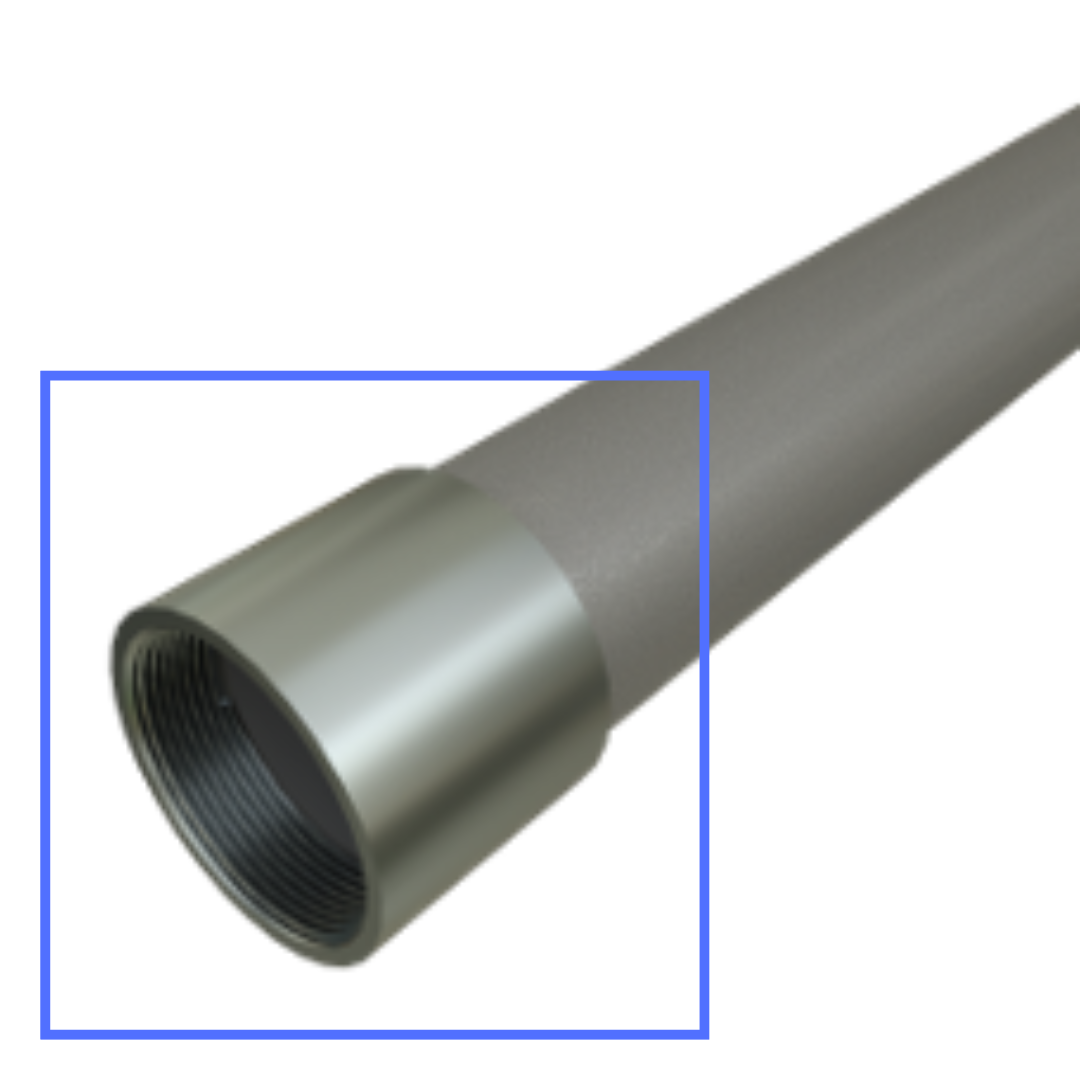
| Figure 1 A standard coupling for RMC shown inside the blue box. |
The rule of tightened fittings has never applied to standard couplings, and it still does not apply. Before, this rule was exclusive for threadless fittings such as set screw or compression couplings and connectors. For threaded fittings such as a three-piece fitting or a union, there were no rules…until now. These threaded fittings now must be made tight, and be listed for wet locations and concrete-tight when needed.
CONCLUSION
The changes to Sections 342.42 and 344.42 in the 2026 NEC were intended to specify that both threadless and threaded fittings must be made tight, with concretetight and wet location listings where needed. However, users may interpret this language as the standard couplings that accompany IMC and GRC to require a separate wet location rating: this is not the case. Since the standard coupling is considered part of the conduit and is listed to UL 1242 and UL 6, the entire assembly is already permitted to be used in wet locations.